How Much Sand and Cement Do I Need for a Patio? A Practical Mix Calculator Guide

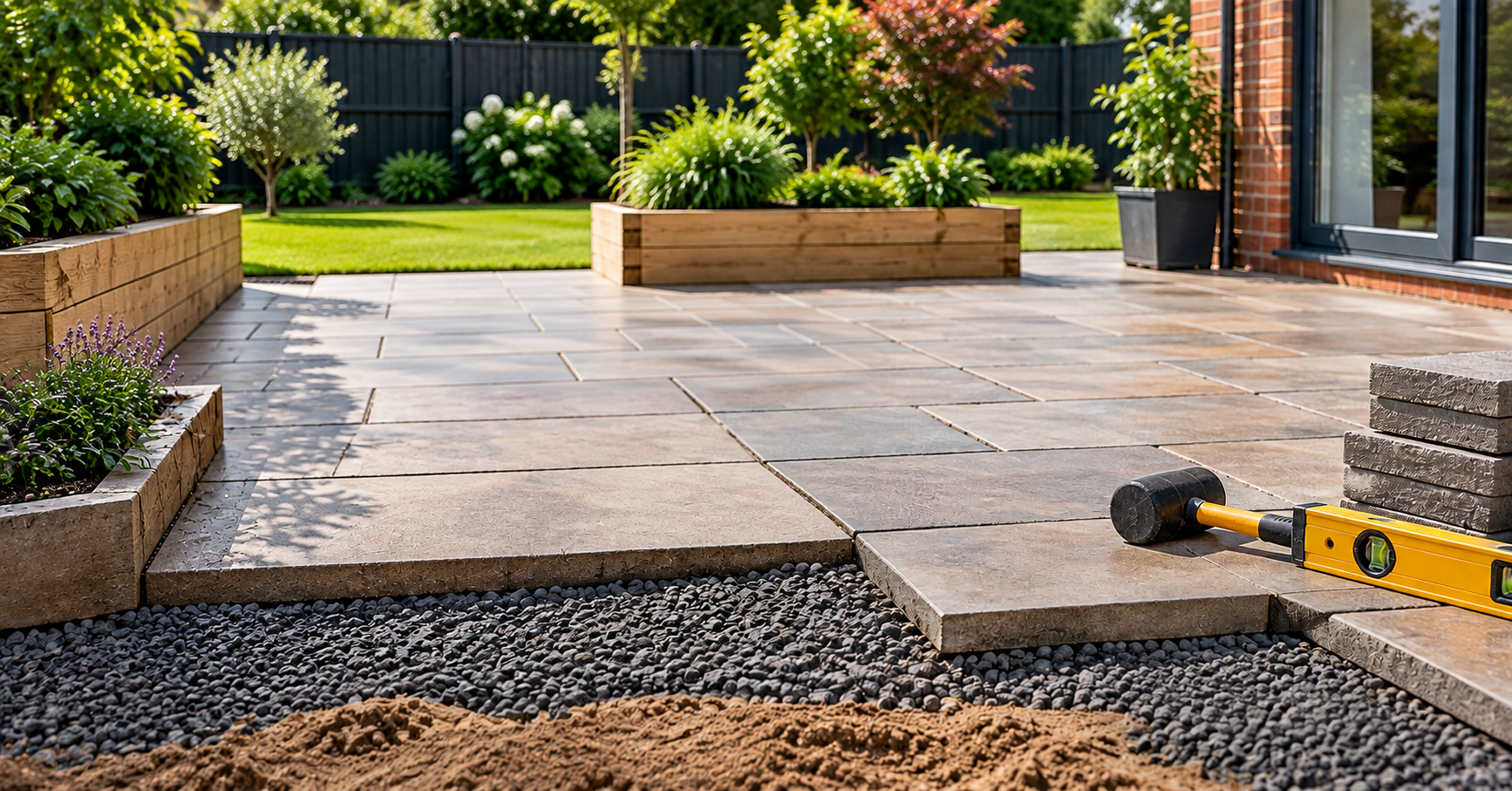
Working out sand and cement for a patio is more than multiplying the patio area by a guessed bag count. The mix depends on whether you are bedding slabs on a mortar bed, pointing joints, or both. This guide shows how to measure each part of the job and use the Handyman Hub sand and cement calculator to build a sensible order.
First decide what the mix is for
A patio can use cement and sand in several different places. A full mortar bed, a spot bed, a bedding haunch around an edge, and jointing all have different quantities and performance requirements. Do not combine them into one rough “cement per square metre” figure.
Porcelain paving usually needs a full, well-compacted bed and careful coverage. Natural stone and concrete flags may use a different bed specification. Follow the paving manufacturer’s installation method before choosing a ratio or thickness.
Measure the patio in sections
Measure each rectangle as length × width. Split an L-shaped patio into two rectangles and add them. Record steps, borders, paths and small repairs separately because they may use another thickness or mix.
Use the finished paved footprint for the bed calculation. The excavation and sub-base quantities are different jobs; link to the patio calculator for the slab and layout side of the project.
Worked example: a 4.8 m × 3.6 m patio
The area is 17.28 m². If the specified mortar bed averages 50 mm, the wet mortar volume is 17.28 × 0.05 = 0.864 m³. That is the volume of finished mortar, not the number of bags. Dry sand and cement occupy more volume than the compacted finished bed, so use the calculator’s yield assumption or the product data sheet.
If the bed is not level and varies from 35 mm to 70 mm, calculate with the average thickness only after checking the low and high points. A thin patch in one corner can change the order and may indicate that the sub-base needs correcting first.
Use the sand and cement calculator step by step
- Open the sand and cement calculator.
- Select the same units used on the paving quote.
- Enter each bed section and the specified average thickness.
- Select the mix ratio or product yield that matches the method you will use.
- Add a realistic allowance for handling and small variations.
- Record cement bags and sand volume separately.
- Save the result with the paving type, bed thickness and supplier assumptions.
For a large or technically demanding patio, have the intended build-up checked by the paving supplier or a competent installer. The calculator helps with quantity planning; it is not a structural specification.
Mix ratio and product yield
A traditional sharp-sand mortar may be expressed as parts sand to one part cement, but the correct ratio depends on the paving system, exposure and manufacturer’s instructions. Pre-batched bedding products use their own coverage and yield figures. Never swap a bag’s stated yield for a generic internet estimate without checking the label.
Keep the calculation consistent. If the supplier gives coverage per 25 kg bag at a stated thickness, use that coverage directly. If you calculate volume, use the dry-volume conversion supplied for the mix rather than treating wet mortar volume as dry sand volume.
Jointing is a separate order
Patio joints consume material around every slab edge, and the amount changes with joint width, depth and slab size. A narrow joint on large slabs can use less material than a wide joint on small flags, even when the patio areas are identical.
Use the product’s coverage calculator or technical sheet for resin, brush-in or cementitious jointing products. Do not use leftover bedding mortar for a jointing system that requires a different product or curing method.
Account for borders, steps and repairs
A border can have a different slab width and a different bed depth. Measure it separately. Steps need tread beds, riser details, nosings and side returns, each with their own areas and thicknesses.
For a small repair, measure the actual patch and keep the mix quantity separate from the main order. A small repair may still need a complete bag because the material is sold in fixed pack sizes.
Common sand-and-cement mistakes
Using area alone
Area without thickness cannot give a reliable mortar volume.
Confusing the bed with the sub-base
Sand and cement mortar is not a substitute for a correctly compacted sub-base.
Ignoring uneven ground
Measure high and low points and use a defensible average thickness.
Mixing jointing into the bed calculation
Jointing has a different coverage basis and should be listed separately.
Buying only the exact calculated amount
Allow for small variations, waste, damaged bags and practical pack rounding.
Patio materials checklist
- Finished paved area by section.
- Specified bed thickness and mix method.
- Sand type and stated yield.
- Cement or pre-batched bedding product.
- Jointing product and joint width.
- Sub-base aggregate, calculated separately.
- Edge restraint, drainage and delivery access.
- Small allowance for handling and unavoidable waste.
The Pavingexpert reference library is useful for understanding paving build-ups, bedding and jointing details. Use the product manufacturer’s instructions as the final authority for the system you choose.
Frequently asked questions
How much sand and cement do I need for a patio?
It depends on the patio area, bed thickness, mix ratio and dry-material yield. Calculate each section rather than using one universal bag rule.
What thickness should a patio mortar bed be?
Use the paving manufacturer’s specified build-up. Thickness can vary with paving type, ground conditions and the chosen installation system.
Can I use building sand under paving?
Use the sand and bedding material specified for the paving system. Sharp sand, specialist bedding products and jointing materials are not interchangeable by default.
Do I need cement for a patio jointing mix?
Some jointing systems use cement, while others are resin or polymer based. Follow the product instructions and calculate its coverage separately.
Should I add waste to sand and cement?
Allow for handling, uneven thickness and pack rounding, but base the allowance on the measured job and product data rather than an automatic percentage.
Does the calculator include the sub-base?
No. Use the aggregate calculator for sub-base quantities and keep that material line separate.
Final mix check
Before ordering, compare the saved calculator result with the patio sketch, bed thickness, mix or product yield, jointing method, borders, steps, sub-base and delivery plan. That review gives you a usable shopping list instead of a misleading single bag estimate.