


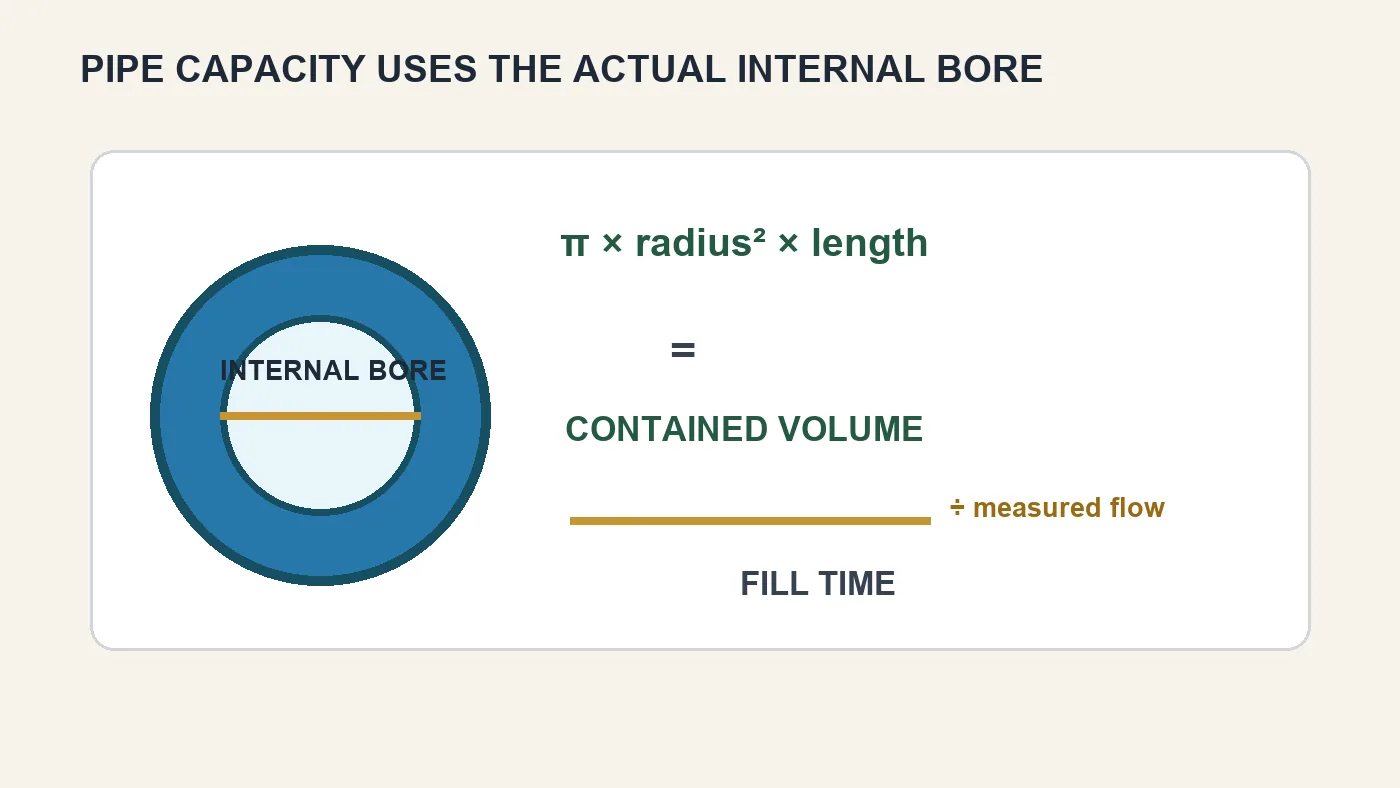
A pipe’s water capacity is a geometry question: use the actual internal bore and the measured centreline length. Fill time is a separate question: divide the amount still required by a measured net flow. Neither result tells you whether the pipe, pump or pressure is suitable for the system.
This guide shows how to measure a run, use the free Pipe Volume & Fill Time Calculator, reproduce a 10-metre worked example and avoid the nominal-size mistake that can quietly distort the answer.
The direct answer
Capacity = π × internal radius² × length. A 10 m pipe with a true 100 mm internal bore holds about 78.54 litres. At a measured 12 litres per minute, ideal continuous fill time is about 6 minutes 33 seconds.
Measure the space that water actually occupies
Water fills the opening inside the pipe. It does not occupy the wall, so an outside diameter overstates capacity. A nominal or trade size can also differ from the physical bore. Material, wall class, schedule, pressure rating and manufacturing system can all change the inside dimension for a similarly named product.
ISO’s published DN definition describes it as a dimensionless designation indirectly related to physical size and warns that it is not a measurable value for calculation unless a standard says otherwise. The International Fuel Gas Code’s published dimension tables likewise show different internal diameters for nominal steel and copper sizes. For a capacity estimate, use a manufacturer’s internal-diameter table for the exact product or measure an accessible clean cut end.
How to measure a pipe run accurately
- Identify every size: split the system where internal bore changes.
- Measure centreline length: follow the pipe route rather than a straight point-to-point shortcut.
- Confirm true internal bore: use the product specification or measure internally with suitable calipers. Do not assume the outside dimension is the bore.
- Count identical runs once: enter one run and use copies. Avoid entering a combined length and multiplying it again.
- List other known capacity separately: vessels, filters or large components can be added from reliable stated or measured volumes.
For an existing system, drawings can be a starting point but should be checked where accessible. Alterations, flexible connections and replacement sections may differ from the original plan. Do not dismantle pressurised, hot, contaminated or otherwise hazardous pipework merely to obtain a measurement.
How to use the pipe volume calculator
- Choose metric metres/millimetres or imperial feet/inches. This converts pipe dimensions; it does not decide which gallon definition you mean.
- Enter the length of one run and the number of identical copies.
- Select actual internal diameter, or derive bore from a known outside diameter and one-wall thickness.
- Enable several pipe runs for mixed sizes. Each row needs a name, length, actual internal bore and copies.
- Add measured component capacity only for volume not already represented in the pipe lengths.
- Enable remaining volume when the system is partly full; add repeat cycles only when the same assessed volume genuinely repeats.
- Enable fill time and enter a measured rate, or enter a collected volume and timed seconds.
- Add water and labour costs only when needed, keeping unattended flow time separate from hands-on labour.
The alternative bore calculation is outside diameter minus twice the wall thickness. There is a wall on both sides of a cross-section. If you enter a combined wall thickness as though it were one side, the calculated bore will be too small.
Worked example: 10 m with a 100 mm internal bore
Convert the bore to metres: 100 mm = 0.1 m. The radius is 0.05 m. Cross-sectional area is π × 0.05² = 0.00785398 m². Multiply by 10 m of length to get 0.0785398 m³. One cubic metre is 1,000 litres, so capacity is 78.5398 litres.
In the calculator choose metric, enter 10 m, one copy and 100 mm actual internal bore. Leave optional sections off. The live result should show approximately 78.54 litres, 20.75 US gallons and 17.28 imperial gallons.
Notice how strongly bore affects the answer. Keeping length at 10 m but doubling the bore to 200 mm produces about 314.16 litres, four times the capacity. Diameter is squared, so a small bore error matters more than the same percentage error in length.
Deriving bore from outside diameter and wall thickness
Suppose a pipe is genuinely measured at 110 mm outside diameter with a uniform 5 mm wall. Bore is 110 − (2 × 5) = 100 mm, returning the same 78.54-litre result for 10 m. Use dimensions from the same product and condition. Coatings, liners, scale or deformation can reduce effective capacity, but this simple calculator does not model them.
For irregular or heavily fouled systems, a geometric answer may be a planning upper bound rather than the usable capacity. Record that limitation instead of pretending an overly precise number is measured fact.
Mixed sizes, fittings and components
Calculate each bore-and-length combination separately, then sum the volumes. A short large-bore header can hold more than a long small branch. The calculator’s bulk rows make the source of the total visible and reduce the risk of applying one diameter to an entire mixed system.
Ordinary fittings are often left inside the run assumption for a rough job estimate. Large filters, vessels or manifolds may deserve a separate capacity from reliable documentation or physical measurement. Add each volume once. If a manufacturer’s assembly volume already includes its internal connecting pipe, do not repeat it as linear pipe.
Fill time starts with a real flow measurement
Diameter does not establish the delivered flow. Pressure, elevation, valves, restrictions, supply capacity, trapped air and pump behaviour all affect the real rate. Measure at the relevant outlet under representative operating conditions, or use a suitable instrument and method.
A simple container test divides known collected volume by elapsed seconds, then multiplies by 60. Five litres collected in 25 seconds equals 12 L/min. Filling 78.5398 litres at a constant net 12 L/min takes 6.54498 minutes, about 6 minutes 33 seconds.
That is continuous net inflow arithmetic. It excludes connection time, venting, pauses, changing supply and control actions. If the pipe is already 25% full, 75% remains: about 58.90 litres, taking about 4 minutes 55 seconds at the same measured rate.
US gallons and imperial gallons are different
One US liquid gallon is 3.785411784 litres; one imperial gallon is 4.54609 litres. The calculator reports both explicitly. Pipe dimensions being entered in feet and inches does not automatically make an unlabeled flow reading a US gallon. Use the convention printed on the container or instrument.
Capacity is not hydraulic design
A correct contained volume cannot select pipe size, calculate pressure loss, prove flow at an appliance or choose a pump. Those decisions need system-specific hydraulic work, product data and applicable rules. The calculator also does not create flushing, disinfection, chemical dosing or wastewater procedures.
Use the result as a transparent quantity in a wider plan. The channel drainage calculator covers separately specified drainage components, the prefabricated pool planner handles a wider installation plan, and the pressure-washing calculator can estimate cleaning water from measured flow and operating time.
A practical site checklist
- Record product, material and wall specification beside every bore.
- Mark where the line changes size or branches.
- Measure route length consistently along the centreline.
- State whether components and fittings are included.
- Time flow under the conditions expected during filling.
- Plan air release, supervision and overflow control separately.
- Save the calculator printout with measurement sources and date.
If the result will drive purchasing, treatment or commissioning, have the assumptions reviewed by the person responsible for the system. A capacity estimate is useful because it exposes the numbers; it should not hide decisions outside its scope.
Common estimating mistakes and how to catch them
The quickest sense check is to compare similar runs. Capacity should double when length or copy count doubles, and it should multiply by four when bore doubles. If it does not, look for mixed units, a diameter entered as a radius, or a copy count already included in the length. A result many times larger than expected often comes from entering millimetres in a field currently set to inches, or using outside diameter as bore.
Another common error is false precision. A calculator may show decimals even when the length was paced out and the bore was guessed from a trade name. Round the decision to match the weakest measurement, while retaining the exact calculation in the record. Write “approximately 79 litres based on 10.0 m and specified 100 mm ID,” rather than presenting an unmeasured system as 78.5398 litres.
Check whether the run is actually full
The full-cylinder formula assumes the line is completely occupied by liquid. High points, trapped air, isolation, branches and drain-down can change the volume actually introduced or recovered. The calculator’s remaining percentage is a planning input, not a sensor reading. If the state matters, establish it with a suitable commissioning or measurement method.
For drain-down planning, contained volume is only one part of the question. Residual pockets, elevation, safe isolation, fluid temperature and contamination determine how work should proceed. Do not use the arithmetic as permission to open a system.
Worked mixed-run example
Consider 12 m of 25 mm internal bore plus two identical 4 m branches of 15 mm bore. The main holds about 5.89 litres. Each branch holds about 0.707 litres, so two hold about 1.414 litres. Combined pipe capacity is roughly 7.30 litres before any separately assessed components.
Entering these as two rows makes the logic visible: “Main, 12, 25, 1” and “Branches, 4, 15, 2” in metric mode. This is safer than finding a fictional average diameter, because volume depends on the square of each bore. Add a documented 2.5-litre filter volume and the system total becomes about 9.80 litres.
How to present the result to someone else
A useful handover states the units, internal-diameter source, measured lengths, included components, assumed starting fill, flow-measurement method and exclusions. Include both the capacity and the operational interpretation: “9.8 L estimated system capacity; fill time based on measured 6 L/min; hydraulic performance and venting not assessed.”
This short qualification protects the value of the estimate. The reader can see what to update when a pipe size, component or flow condition changes, rather than treating the output as an unexplained fixed fact.
Frequently asked questions
Should I enter nominal size or internal diameter?
Use the actual internal bore for the specific pipe. Nominal size is a designation and may not equal the opening that holds water.
Can I use outside diameter?
Only with the known one-wall thickness so the bore can be derived. Outside diameter alone overstates the water space.
How do I calculate several pipe sizes?
Enter each distinct length, actual bore and copy count as a separate bulk row. The calculator shows and sums the run capacities.
Do elbows and fittings change capacity?
They can. For rough work they may be minor; add a reliable component volume where their capacity is material to the decision.
Does a larger pipe fill faster?
Not from size alone. It holds more water, while actual fill speed depends on net delivered flow and system conditions.
Can I derive pressure or pump size from fill time?
No. The calculation is volume divided by entered flow and is not a hydraulic model.
Does 50% full always mean half the water depth?
No. In a horizontal circular pipe, half volume occurs at half depth, but other partial depths do not scale linearly with volume.
Which gallon should I use?
Use the definition stated on your measuring device or source. The calculator distinguishes US liquid and imperial gallons.
Is fill time paid labour time?
Not automatically. Add hands-on attendance separately and avoid charging passive flow time as active work without justification.
When should I remeasure flow?
Remeasure when the supply, outlet, restrictions, elevation or operating arrangement changes, and whenever the first measurement was not representative.