


A sustainable contractor rate has two tests. First, annual revenue from realistic billable hours must cover the owner’s income target and business expenses. Second, completed jobs must actually deliver the expected surplus after every direct cost and every hour of personal time is counted. Passing only one test can leave a busy business short of cash.
This guide uses the free Hourly and Day Rate Calculator to set a baseline, then the Job Profit Calculator to check what an individual job really paid. It is a planning framework, not tax, legal or accounting advice.
The direct answer
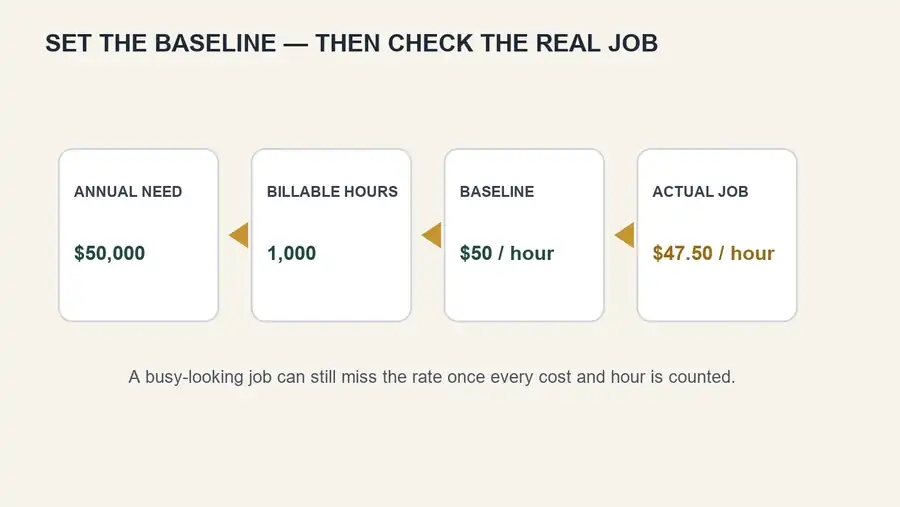
If you need $40,000 for owner income and $10,000 for annual business expenses, you need $50,000 before any extra allowance. At 50 weeks × 5 days × 8 hours with only 50% billable, that is 1,000 billable hours and a baseline of $50 per billable hour. The average target across every working day is $200 because each day contains four billable hours on average, not eight.
Start with the annual business, not a competitor’s hourly number
A nearby contractor’s advertised rate tells you very little about the number your business needs. Their vehicle, insurance, tools, family income requirement, service area, staff, non-billable workload and tax position may all differ. Begin with your own annual targets and documented expenses, then compare the result with the market and the value of the service.
List the owner income the business must generate before personal taxes, then list business expenses separately. Typical headings include vehicle costs, insurance, licenses, tools, software, accounting, marketing, phone, workspace, training, bad debts and payment fees. Avoid counting the same cost both in annual overhead and again inside every job unless that duplication is intentional and documented.
Joist’s contractor pricing guide gives a useful independent explanation of burdened labor, overhead recovery and the difference between markup and margin. Its figures are examples, so use your own books and professional advice for your business.
Billable hours are smaller than working hours
A self-employed contractor can work eight hours without selling eight hours. Quoting, calls, scheduling, loading, travel, buying materials, maintenance, bookkeeping, collections, training and rework all consume time. Some of those costs may be recovered through call-out charges, material handling, job pricing or overhead, but they remain part of the working year.
Estimate total working capacity first: weeks worked × days per week × hours per day. Then apply a realistic billable percentage based on records. If you have no records, make a cautious starting assumption and track the next month in simple categories. Do not select 90% merely because the calculator produces a more attractive rate.
How to use the hourly and day rate calculator
- Choose the currency that matches your planning figures. The selector labels the results; it does not supply local prices, taxes or rules.
- Enter the annual owner income target. Keep its meaning consistent with the calculator description.
- Enter annual business expenses from records or a reasoned forecast.
- Add any allowance only once. Label what it covers so it does not duplicate an expense or profit included elsewhere.
- Enter working weeks, days per week and hours per day. Remove planned holidays and realistic downtime.
- Enter the percentage of those hours that can actually be billed or recovered through customer work.
- Review annual billable hours, required hourly rate and average working-day revenue target together.
- Save the assumptions and date. Recalculate when expenses, capacity or billable utilization changes.
Worked annual-rate example
Use $40,000 owner income plus $10,000 annual business expenses. Work 50 weeks, five days and eight hours per day. That is 2,000 working hours. At 50% billable utilization, the business has 1,000 billable hours. Divide the $50,000 requirement by 1,000 and the baseline is $50 per billable hour.
The calculator’s $200 average working-day revenue target is $50 multiplied by the average four billable hours within each eight-hour working day. It is not a recommendation to work only four hours, and it does not mean an eight-hour customer day should be quoted at $200. It shows how billable and non-billable work share the annual target.
| Annual input | Example | Meaning |
|---|---|---|
| Owner income target | $40,000 | Planned amount generated for the owner before personal treatment |
| Business expenses | $10,000 | Documented annual operating costs |
| Working capacity | 2,000 hours | 50 × 5 × 8 |
| Billable share | 50% | 1,000 recoverable hours |
| Baseline rate | $50/hour | $50,000 ÷ 1,000 |
This is a break-even planning baseline under the stated assumptions. It does not automatically include sales tax, income tax, a separate profit return, contingencies or the cost of employing other people. Decide how each item is treated and get advice for your jurisdiction.
Turn the annual baseline into quotes
An hourly baseline is an internal cost-recovery tool. A customer quote still needs a defined scope, estimated labor, materials, subcontractors, equipment, disposal, permits where relevant, risk and a clear commercial allowance. The job-pricing guide explains that estimate structure, while the labor and duration calculator helps separate person-hours from elapsed schedule.
Do not promise a fixed price by multiplying an uncertain hour guess by the minimum hourly baseline. Break the job into tasks, record exclusions and decide how changes will be handled. Small jobs may need a minimum charge because travel and administration exist even when site work takes twenty minutes.
Why a profitable-looking job can still underpay you
A job can show money left after materials and still miss the hourly target. The missing pieces are often personal time, travel, small consumables, disposal, payment fees or an expense paid earlier in the month. Check the job after completion with the customer price, direct costs and every owner hour connected to that job.
Job surplus is customer price minus the costs entered. True hourly earnings in the calculator are that surplus divided by total personal hours. This is not necessarily the same as accounting net profit or taxable income. It is a practical job-level signal that shows whether the work rewarded the time at the target rate.
How to use the job profit calculator
- Enter the amount the customer paid or the agreed price being reviewed.
- Enter materials at their real cost, including delivery and non-returnable surplus where appropriate.
- Add travel, subcontractors, hire, disposal, permits, consumables and other direct job costs in the available fields.
- Enter all personal time: estimating, sourcing, loading, travel, site work, cleanup, invoicing and callbacks attributable to the job.
- Enter the target hourly earnings from the annual-rate exercise.
- Review surplus, hourly earnings, margin and target price. Keep their definitions visible.
- Compare estimate with actual and write down the cause of any difference.
Worked job-profit example
A customer pays $500. Materials cost $100 and travel costs $20. Total direct costs are $120, leaving $380 before any annual overhead that has not already been allocated. If the contractor spent eight total personal hours, the result is $47.50 per hour. That misses the $50 target even though the job appears to have a healthy $380 surplus.
The displayed margin is 76% because $380 divided by the $500 selling price equals 0.76. To deliver $50 per hour for eight hours while covering the same $120 of direct cost, the target price is $520. That is $400 for time plus $120 of costs. The example assumes the $50 target already deals with annual expenses in the way established earlier.
| Job item | Example | Result |
|---|---|---|
| Customer price | $500 | Revenue received/quoted |
| Materials + travel | $120 | Direct costs entered |
| Surplus | $380 | $500 − $120 |
| All personal time | 8 hours | Not site time alone |
| Hourly earnings | $47.50 | $380 ÷ 8 |
| Price at $50/hour target | $520 | $120 + (8 × $50) |
Markup and margin are not interchangeable
Markup compares the amount added with cost. Margin compares surplus with selling price. If cost is $100 and you add a 20% markup, the selling price is $120 and the $20 surplus is a 16.67% margin. To produce a 20% margin on a $100 cost, divide by 0.80, giving $125.
Confusing these percentages can steadily underprice work. Record the formula next to the percentage used in your estimate. Never write “20% profit” when the spreadsheet is applying a 20% markup. The Joist guide linked above illustrates the same distinction in a contractor context.
Track time without turning the day into paperwork
Use a small number of repeatable categories: quote/admin, travel/sourcing, site work, cleanup and callback. Start a timer or note the time when the activity changes. The goal is reliable feedback, not a minute-by-minute surveillance system.
Review completed jobs weekly. Look for consistent underestimates: collecting materials, protection and setup, customer communication, second visits, drying waits or disposal. Update the task estimate or minimum charge instead of merely promising to work faster next time.
Separate direct job costs from annual overhead
A direct cost belongs to a particular job, such as its tile, hired access tower or disposal charge. Overhead supports the business across many jobs, such as annual insurance or bookkeeping software. The division must be consistent. Vehicle fuel might be entered as a direct trip cost, recovered through mileage, or forecast in annual overhead; counting it in all three places overstates cost.
Create a short written policy for recurring items. Decide where card fees, small consumables, warranty visits and tool wear are captured. Reconcile the forecast with actual accounts periodically. A calculator cannot detect a cost that was never recorded.
Cash flow is different from profit
A profitable job can still strain cash if materials are paid weeks before the customer pays. Deposits, stage payments, supplier terms and invoicing speed affect cash timing. Conversely, a large deposit can make the bank balance look healthy before the work and remaining costs are complete.
Keep a cash forecast beside the job-profit review. Define payment stages clearly and comply with the rules that apply to deposits and consumer contracts in your location. Do not use customer money reserved for a project as evidence that the business has earned the same amount.
Taxes and owner pay need clear labels
Sales tax collected for an authority is not business revenue available to spend. Personal income taxes and self-employment obligations also need planning. The correct treatment varies by business structure and jurisdiction, so confirm it with a qualified adviser. Keep tax reserves out of casual “money left over” calculations.
Label the annual income target carefully: gross owner pay before personal taxes, a draw, salary or another measure. Changing the meaning between months makes the calculated rate impossible to compare.
Use three review cycles
- Every job: compare quoted and actual time, direct cost and hourly result.
- Every month: compare billable utilization, revenue and overhead with the plan.
- Every year or major change: rebuild the annual rate from current targets, expenses and capacity.
If the rate rises sharply, inspect the assumptions before rejecting it. The billable percentage may have been unrealistic, an expense may be duplicated, or the old rate may simply have been too low. A clear scope, efficient systems and the right mix of work can matter as much as changing the headline hourly number.
Common pricing mistakes
- Using 2,000 billable hours because 2,000 hours are worked.
- Leaving owner quoting, travel and cleanup out of completed-job time.
- Copying a competitor without knowing their costs or scope.
- Adding a markup while calling it the same percentage margin.
- Counting materials but forgetting delivery, disposal and payment fees.
- Using the minimum baseline as a complete fixed-price quote.
- Counting annual overhead twice or omitting it entirely.
- Reviewing only good jobs and never recording callbacks.
Frequently asked questions
Is my hourly rate the same as my wage?
No. A customer-facing rate must help recover non-billable time and business costs as well as the owner income target and any separately planned commercial allowance.
What is a billable hour?
It is an hour whose cost is recovered through customer work under your pricing method. Many necessary working hours are not directly shown as an hourly line on an invoice.
Why is the average day target lower than eight times the hourly rate?
The calculator spreads the annual requirement across all working days. If only half of working time is billable, an average eight-hour day contains four billable hours.
Should travel time count?
It must be recovered somewhere. You may charge it directly, use a call-out or zone charge, or include it in overhead and pricing. Keep the method consistent and transparent.
Does the job-profit result equal taxable profit?
Not necessarily. It is a planning result based on entered costs and time. Accounting and tax profit may include different allocations and rules.
What is the difference between markup and margin?
Markup is surplus divided by cost; margin is surplus divided by selling price. The same job produces different percentages.
Should I include quoting time in the job review?
Yes when it is attributable to that job. Repeated unsuccessful quotes may instead be monitored as wider overhead or sales time, but they still affect annual billable capacity.
Can I charge a day rate?
You can, but define what the day includes and compare the day price with the annual revenue target, likely billable hours and job-specific costs.
How often should I change my rate?
Review it at least annually and whenever costs, capacity, services or billable utilization change materially. Review job performance much more often.
What if the calculated rate is higher than customers will accept?
Check the assumptions, scope, market and service mix. Improve utilization or efficiency where realistic, clarify value and remove scope rather than quoting below a number that cannot sustain the business.