
Wallpaper is bought as rolls, but it is used as full-height strips called drops. That distinction matters. A roll can contain enough square footage for a wall and still be one usable drop short after trimming and pattern matching.
Count the drops needed across the walls, calculate the cut length of each drop, find how many whole drops fit on one roll, then round the roll count up. The free wallpaper calculator handles free, straight and half-drop matches and can include adhesive, labor and project cost.
This guide helps plan quantities. It cannot confirm wall condition, adhesive compatibility, batch consistency or the correct hanging method for a particular wallcovering. Read the label and the manufacturer’s instructions before ordering or cutting.
Four label details control the estimate
Before measuring the room, record the roll width, roll length, vertical pattern repeat and match type. A standard-looking roll is not a reliable assumption. Wider designer papers, murals and commercial wallcoverings can use different dimensions and installation rules.
The vertical repeat is the distance before the design repeats vertically. The match type describes how adjacent drops align. The Wallcoverings Association’s pattern-match guide distinguishes random, straight-across and drop matches. A free or random match generally creates less repeat waste; a straight match aligns neighboring strips at the same height; a half-drop offsets alternate strips.
Also record the batch, lot or run number. Rolls of the same pattern ordered at different times may vary in color. The Association’s residential installation guidance advises checking roll tickets and accounting for the pattern match before cutting.
Measure total wall width, height and awkward areas
Measure every wall you will paper at the top, middle and bottom. Use the largest relevant width when walls are not parallel. Measure height in several places and use the tallest point needed for full drops. Note sloped ceilings, stairwells, deep reveals and walls taller than a single usable drop.
For a simple room, add the widths of the decorated walls. Divide that total by the usable roll width and round up to get the number of drop positions. Do not round each wall down and hope a narrow remainder can be patched from scraps.
Doors and windows do not always save a full drop
A window removes area, but the paper above and below it may still come from a full-height drop so the pattern stays continuous. For a cautious first estimate, count full drops across openings, then let an experienced installer identify reusable pieces. Large picture windows, wide doors and separate wall groups can justify a more detailed cutting plan.
If the calculator offers opening deductions, use them only when the cutting logic matches the room. A square-foot deduction cannot guarantee that an offcut has the right length, width or pattern phase for another location.
How to use the wallpaper calculator
1. Choose Metric or Imperial and enter the decorated walls
Select one unit system and keep it throughout the calculation. Enter either the room dimensions or the total wall width requested by the tool. Use actual decorated height rather than a nominal ceiling height. Add a top-and-bottom trimming allowance supported by the product and hanging method.
2. Enter the physical roll size from the product
Type the roll width and length exactly as sold. US products may be described as single or double rolls; use the physical packaged dimensions required by the calculator rather than the naming convention alone. Metric rolls also vary, despite 0.53 by 10.05 meters being common.
3. Select the printed match type and repeat
Choose free/random, straight or half-drop to match the label. Enter the vertical repeat, not the roll width and not the horizontal design repeat. Graham & Brown’s wallpaper terminology guide explains that pattern repeat is the vertical distance between identical points and that match information appears on the product page.
For a straight match, a practical calculation rounds each trimmed drop length up to the next complete repeat. Half-drop planning can alternate pattern positions and may need more sophisticated packing. Treat the calculator’s result as a checked ordering estimate and ask the supplier or installer to confirm an expensive patterned product.
4. Review drops before price
Look at drops required, adjusted cut length, drops per roll and whole rolls. If any roll yields zero drops, the wall is too tall for that roll under the entered assumptions. If one small change in repeat reduces yield from four drops to three, the result can jump by a whole roll; that is expected, not a software error.
5. Add adhesive, labor and markup separately
Use the exact adhesive coverage and compatibility information for the wallcovering. Paste-the-wall, paste-the-paper and pre-pasted products are not interchangeable assumptions. Add labor from the measured complexity, not only the wall area. Pattern alignment, corners, obstacles and surface preparation can dominate the schedule.
Worked example: a pattern repeat changes the roll count
Suppose one feature wall is 4.2 meters wide and 2.4 meters high. The selected roll is 0.53 meters wide and 10.05 meters long. Allow 0.10 meter total trimming per drop. First calculate a free-match paper, then compare a straight match with a 0.64-meter repeat.
| Step | Free match | Straight match, 0.64 m repeat |
|---|---|---|
| Drops needed | ceil(4.2 ÷ 0.53) = 8 | 8 |
| Basic cut length | 2.4 + 0.10 = 2.50 m | 2.50 m |
| Adjusted cut length | 2.50 m | ceil(2.50 ÷ 0.64) × 0.64 = 2.56 m |
| Drops per roll | floor(10.05 ÷ 2.50) = 4 | floor(10.05 ÷ 2.56) = 3 |
| Rolls required | ceil(8 ÷ 4) = 2 | ceil(8 ÷ 3) = 3 |
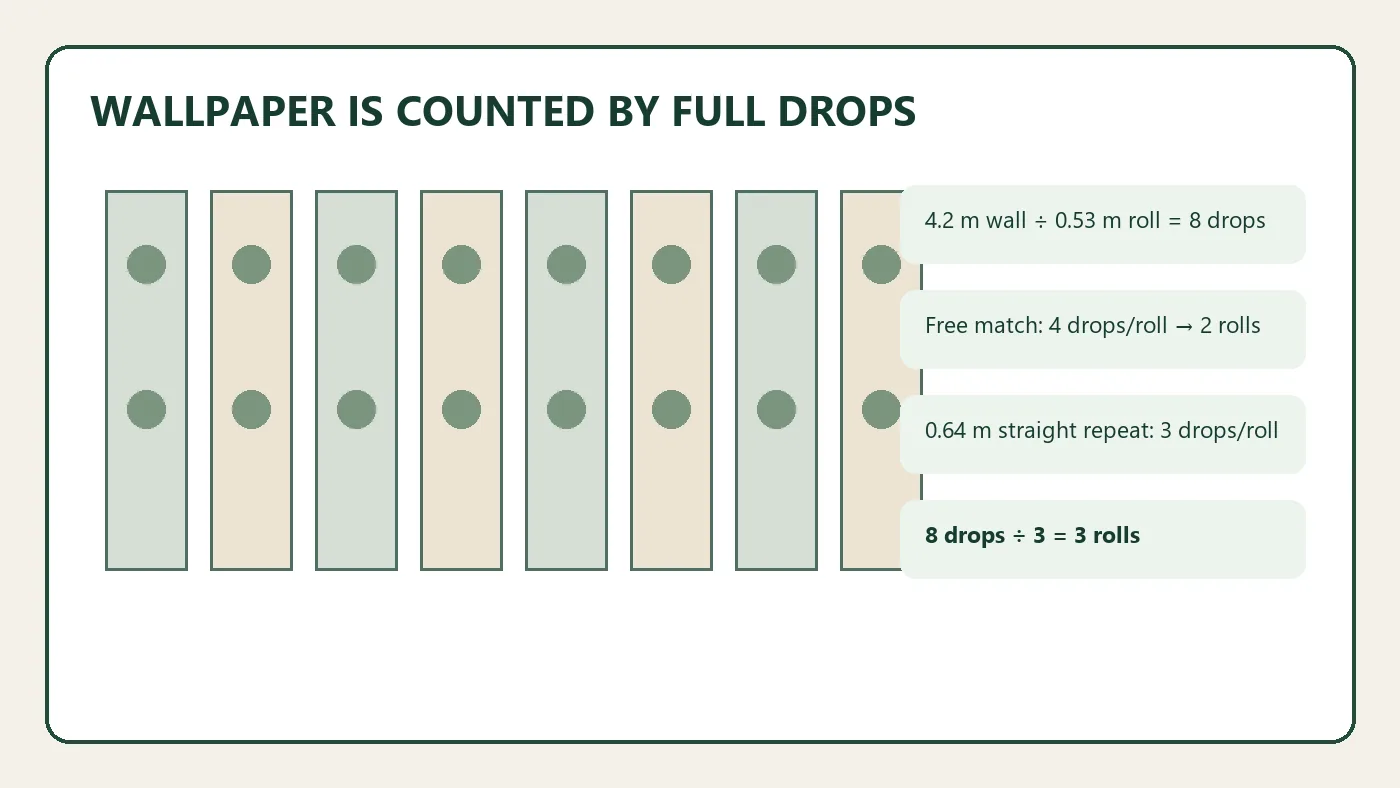
Live-calculator check: the tool returns the same three-roll order. Its detailed engine keeps the 2.50-meter basic cut visible, tracks pattern phase separately, and reports 0.30 meter of alignment waste plus 10.15 meters of purchased length left outside full drops. That is a more detailed packing model than the conservative whole-repeat shortcut in the table.
The wall area is only 10.08 square meters, while two rolls have a nominal physical area of 10.653 square meters. An area-only method therefore suggests two rolls. It misses the fact that two patterned rolls yield only six usable full drops. Counting drops exposes the shortage before the paper is cut.
Imperial comparison
Take a 13-foot-wide wall, 8 feet high, with a 27-inch-wide roll that is 27 feet long. Add 4 inches of total trim. The wall needs ceil(156 ÷ 27) = six drops. Without repeat rounding, each drop is 8 feet 4 inches, so three fit on a 27-foot roll and two rolls provide six drops. A sufficiently large repeat can push the cut beyond 9 feet; then only two drops fit per roll and the order becomes three rolls.
Half-drop patterns need special care
With a half-drop match, alternate strips begin at different positions. Some products can be cut efficiently by alternating from two rolls; others generate additional waste depending on roll length, repeat and room grouping. Use the calculator’s half-drop option when it models that behavior, but preserve the output details and confirm the cutting sequence before opening every roll.
Do not reverse alternate drops unless the manufacturer calls for it. Reverse hanging can reduce shading on some random-match commercial products, but it can ruin a directional design. Match type, hanging direction and adhesive all come from the specific instructions.
Plan the first and last drop before cutting
A mathematically adequate roll count does not choose an attractive starting point. Mark a plumb reference and consider where a dominant motif will land at the most visible wall, chimney breast or corner. Shifting the start can change the width of the first and last pieces, and a very narrow return may be awkward even though the total number of drops is unchanged.
For several walls, number them on the sketch and decide whether the pattern should continue through each corner. Keep cut drops in hanging order and label them on the reverse only where the product instructions permit. This planning does not usually change the basic calculator total, but it can expose a wall group that deserves its own allowance or an extra roll.
Make the final order resilient
Combine walls that use the same pattern, colorway and batch before rounding the final roll count. Keep separate wall groups when their heights differ enough to change drops per roll. Add a deliberate spare only after the drop calculation. A spare from the same batch can be valuable for an installation error or later repair, but it should not conceal uncertain measurements.
Before ordering, ask the supplier to confirm the physical roll size, match symbol, vertical repeat, batch policy and return rules. Save the product page and room sketch. When the rolls arrive, check every ticket before unwrapping or cutting. Lay out enough paper to inspect color and printing; follow the manufacturer’s procedure for reporting defects.
Surface preparation is part of the job even though it is absent from the roll equation. Walls should be sound, appropriately prepared and suitable for the specified adhesive. If the room has fresh plaster, use the plaster quantity guide for material planning, then follow the wallcovering instructions for readiness and preparation.
Final wallpaper-order checklist
- Every decorated wall is measured at more than one point.
- The roll width and length come from the exact product.
- The match type and vertical repeat match the label.
- Trim allowance is explicit.
- Drops required and drops per roll are both visible.
- Openings are handled by a real cutting plan, not area alone.
- Different wall heights are checked separately where necessary.
- All rolls will be ordered from one compatible batch or run.
- Adhesive and wall preparation follow product instructions.
- A spare roll is a conscious decision after calculation.
Wallpaper quantity FAQs
How many rolls of wallpaper do I need?
Divide total wall width by roll width and round up for drops needed. Work out the adjusted length of each drop, divide roll length by that figure and round down for drops per roll. Divide the first number by the second and round up.
Why is wall area divided by roll area unreliable?
It treats every offcut as reusable. In practice, wallpaper must supply whole-height strips with the correct pattern position.
What is a wallpaper pattern repeat?
It is the vertical distance from one point in the design to the next identical point. Matching can require each cut to advance to a complete repeat.
What is the difference between straight and half-drop match?
A straight match aligns adjacent drops at the same vertical point. A half-drop offsets alternate drops, so the cutting sequence and waste can differ.
Should I subtract doors and windows?
Only when the cutting plan shows that the removed area saves usable drops. Paper above and below an opening may still need to come from a full drop.
Can I mix rolls from different batches?
Avoid it where visible color consistency matters. Check all roll tickets and ask the supplier about batch matching before opening them.
How much trim should I add to each drop?
Use the allowance stated or recommended for the product and installation method. Enter the total for top and bottom, and make sure the calculator expects the same convention.
What if the wall is taller than the usable roll length?
A standard vertical drop cannot be cut from that roll. Do not plan a hidden horizontal join without an approved design; ask the supplier or installer about a suitable product or layout.
Should I order a spare roll?
It can be sensible for patterned or batch-sensitive paper, but calculate the required rolls first. Consider cost, return rules and the value of matching repair stock.
Does the calculator choose adhesive?
No. Use the wallcovering manufacturer’s compatible adhesive and preparation instructions. Paste coverage is a separate product calculation.
Ready to count by the drop? Open the wallpaper calculator, reproduce the feature-wall example, then enter the label details and measurements from your own project.