
For a rectangular gabion, multiply the basket’s length, width and height, then multiply by the number of baskets. That gives the space to fill. It does not directly give a stone weight, because a filled basket contains gaps between stones and the mass depends on the rock and how it packs.
The gabion basket and stone calculator keeps basket volume, optional facing stone, core stone and purchasing allowances separate. Use it for a basket schedule that has already been selected. It is not a retaining-wall design tool.
Make a basket schedule, not just a wall length
Write one line for every different basket size and its quantity. Include shorter end units and any change in height or depth. A single overall length times maximum height can overstate a stepped arrangement; using the smallest height can understate it. Dividing a stepped elevation into the actual rectangular units avoids both shortcuts.
Confirm the dimensions used by the supplier. Record whether the quotation includes lids, diaphragms, joining components and required bracing. Those items cannot be recovered from a cubic-yard total. If you already own empty baskets, enter them against the matching type; owning a basket doesn’t mean its stone fill is already on site.
A simple three-basket example
Suppose your approved schedule contains three identical baskets, each 6 feet long, 2 feet deep and 2 feet high. Each basket holds 24 cubic feet geometrically. The total is 72 cubic feet, which is 72 ÷ 27 = 2.667 cubic yards.
Choose Imperial in the live calculator and enter 6, 2 and 2 for the basket dimensions, with a quantity of three. Leave the facing option off and use volume-only mode for the core. With no reserve, the fill volume should correspond to 2.667 cubic yards. That is the clean baseline before adding purchasing assumptions.
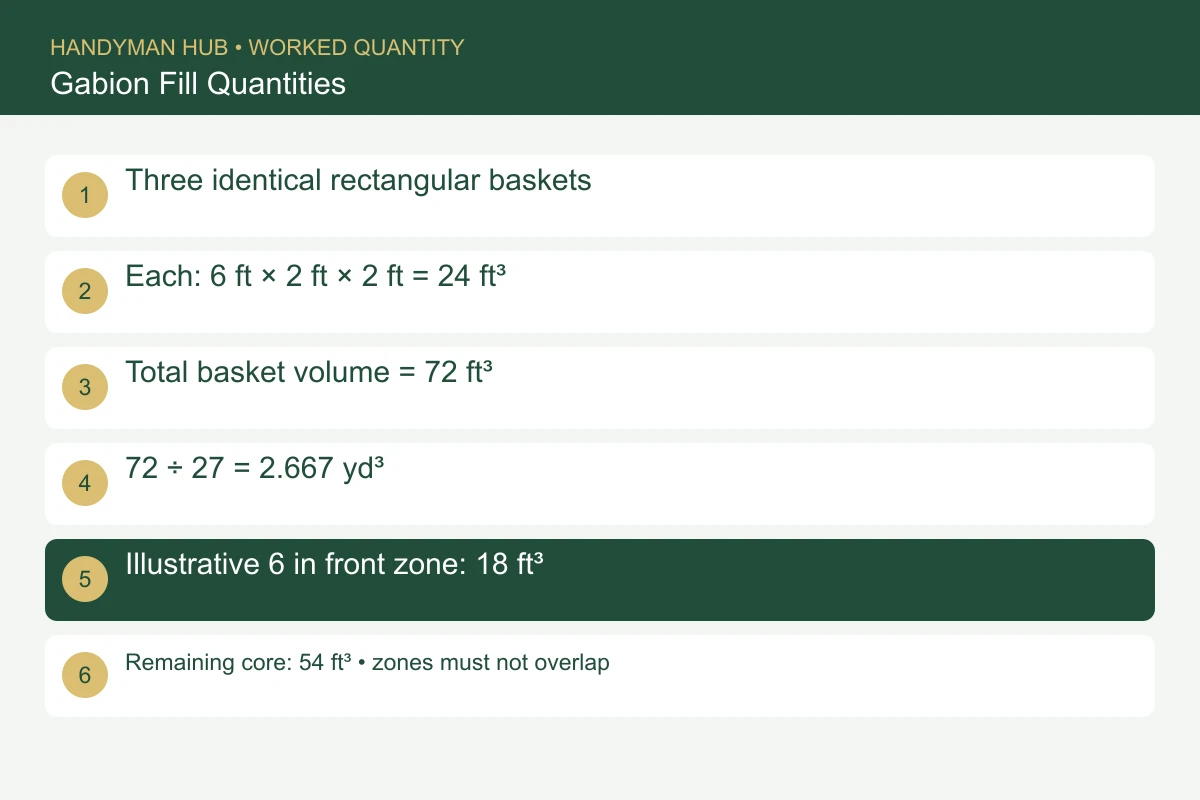
Now consider a separately specified decorative zone 6 inches deep on one length-by-height face of every basket. Its geometry is 6 × 2 × 0.5 × 3 = 18 cubic feet. The remaining core is 72 − 18 = 54 cubic feet. The two zones add back to the total; you haven’t added facing stone on top of a fully filled basket.
This facing example is an accounting exercise, not approval to conceal any arbitrary core material. Both fill types and the separation arrangement must be acceptable for the basket and its purpose. The calculator’s facing option covers the selected long faces; end faces and other decorative details may need their own assessment.
Check stone size against the mesh
A rock description such as “landscape stone” doesn’t establish that it will stay within the mesh or pack as intended. Ask for the grading and the basket supplier’s permitted fill range. Attractive small stones may be unsuitable if pieces can escape through the openings.
Gabion Supply’s product guidance lists different mesh and fill combinations for its basket systems. It also distinguishes those product details from the professional stability assessment needed for retaining walls. Use the exact system’s specification; don’t turn one supplier’s stone range or wall proportions into a universal design rule.
For a decorative freestanding feature, still check the base, restraint and intended use. A stone-filled basket is heavy even when it is short. If it retains soil, supports a seat or borders a drop, its geometry and fill order need the appropriate design assessment before purchasing.
Convert volume to weight on the right basis
Ask the supplier for a bulk fill weight appropriate to the specified stone and packing condition. Do not multiply by the density of solid granite or limestone: that treats the basket as if there were no voids between pieces.
As a transparent hypothetical calculation, 72 cubic feet at 100 pounds per cubic foot would weigh 7,200 pounds, or 3.6 US short tons. The 100-pound figure is deliberately an example, not a quoted density or a national buying rule. Replace it with confirmed data before discussing transport.
If you add a 5% stone reserve to that example, the material allowance becomes 75.6 cubic feet and the matching theoretical mass becomes 7,560 pounds. Supplier order increments may round the purchase further. Keep the geometric basket volume unchanged in your records, so the reason for the extra quantity remains visible.
Where facing and core stone differ, use separate density and price inputs. A combined volume multiplied by one density can disguise that difference. Keep US short tons, metric tonnes and pounds distinct when comparing quotations.
Make delivery practical
Check the access width, surface, turning space and proposed unloading point with the hauler. A calculation of truckloads based on payload alone is only a quantity check; it doesn’t confirm that a vehicle can reach the site or unload safely. If stone comes in bags, confirm lifting arrangements rather than assuming the truck can place every bag beside the baskets.
Allow separately for assembly, stone handling, sorting visible faces and placing fill in accordance with the supplier’s assembly and filling instructions. Those activities can matter to the budget even when the stone volume is modest.
Use our bulk-volume and US-ton guide when checking unit conversions. If the feature sits within a larger garden project, keep its stone separate from the topsoil order and any spoil-removal quantities.
Return to the gabion estimate with the final basket schedule, fill specification and delivered prices. A useful order states both the physical quantity and the assumptions behind it, so a supplier can spot a mismatch before the truck arrives.
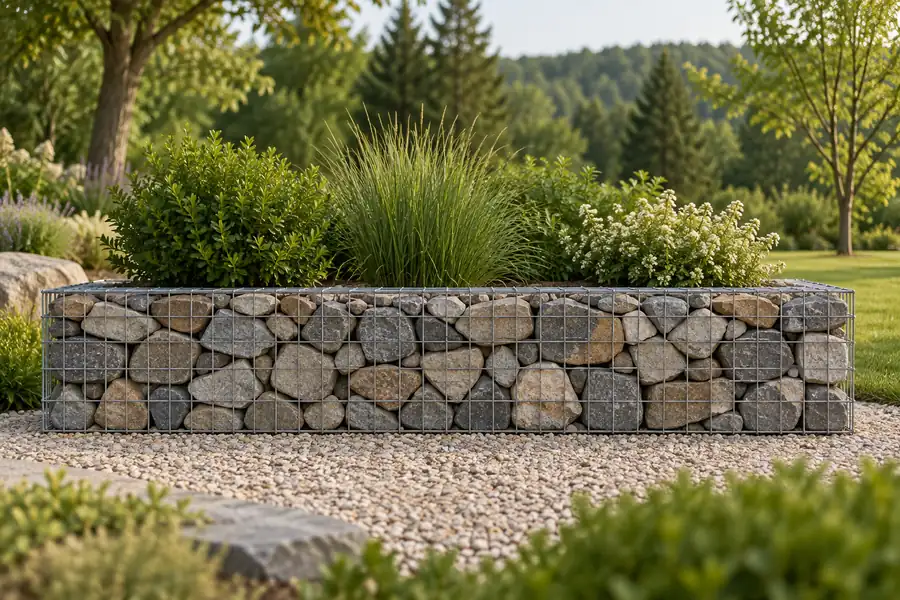
Featured image: original concept illustration, not a completed Handyman Hub customer project.