
A bag that covers 100 square feet does not necessarily cover 100 square feet on your wall. The printed figure only makes sense at the stated thickness, on the intended background and for the named product. Double the average thickness and, as a quantity check, the theoretical coverage roughly halves.
Measure the net surface, keep each plaster layer separate, use the manufacturer’s coverage at its stated depth, apply a deliberate allowance, and round up to whole packs. The free plastering and skimming calculator works with walls and ceilings, finish and backing coats, manufacturer coverage or consumption rates, existing stock, labour and project cost.
This guide is for quantity planning. It cannot diagnose a background, select a plaster system, decide whether an old coating is safe to disturb or replace the product instructions. US readers may know similar thin finishing work as skim coating; UK plaster products and methods are not automatically interchangeable with North American joint compounds or veneer plaster.
Start with the system, not the bag count
Before measuring, identify what will be applied to each surface. A thin finish coat over suitable board, a backing coat over masonry and a repair layer over mixed backgrounds are different jobs. Write the exact product and intended applied thickness beside each wall. If the specification uses two different products, calculate them as two separate materials rather than averaging their coverage together.
Inspect the background for movement, contamination, moisture, failed coatings and large deviations. Quantity arithmetic cannot make an unsuitable surface ready. The Finishes and Interiors Sector plastering guide for homeowners is a useful independent overview of plastering choices and expectations; the selected manufacturer’s instructions remain the controlling source for the product.
Measure walls and ceilings separately
For a rectangular wall, multiply length by height. Subtract doors and windows that will not receive plaster. Measure ceilings by their actual plan dimensions unless the surface slopes; for a sloping ceiling, measure the slope rather than substituting the room’s flat floor area.
Break an irregular room into named surfaces. A clear list such as “north wall, minus door” and “ceiling over main room” is easier to verify than one total entered from memory. If a reveal, column or small return matters to the order, measure it explicitly or include it in a documented allowance.
Thickness must represent the layer being estimated
A finish coat measured in millimeters and a backing coat measured in a larger thickness cannot share one depth. If a wall varies, split it into sensible zones or use a defensible weighted average. Do not apply the deepest hollow across the entire room.
Coverage printed as “X square meters per bag at Y millimeters” already connects area and thickness. If you enter the stated coverage and reference thickness, the calculator can scale the requirement when your specified average thickness differs. Do not scale the figure again outside the calculator.
How to use the plaster and skim calculator
1. Choose units and entry method
Select Metric for meters, square meters and millimeters, or Imperial for feet, square feet and inches. The calculator can display either, but your product data must use the selected units. Currency changes the label only; enter prices in the currency you want reported.
Use individual surfaces for most rooms. Add walls and ceilings one by one, with their openings, so the result can be checked against a sketch. Bulk entry is appropriate when a surveyor or takeoff has already supplied a verified net area.
2. Enter the exact finish product coverage
Choose the manufacturer quantity method that matches the data sheet. If the label gives coverage per bag at a stated thickness, enter both figures. If it gives a consumption rate per unit area and millimeter of thickness, use that method instead. Do not convert between them using an assumed density unless the manufacturer provides the necessary data.
Coverage figures are estimates under stated conditions. Background texture, suction, mixing losses and application can change real use. Gypsumtools’ plastering and drylining articles offer practical trade context, while the product data sheet should supply the numbers entered in the calculator.
3. Add a backing product only when the job uses one
Turn on the second product for a genuine backing or base layer. Give it its own thickness, coverage, pack size and price. A two-coat finish made from one product may be represented by the manufacturer’s stated total system thickness; it should not automatically be entered as two full independent layers. Read the wording on the data sheet.
4. Set extra material and existing stock honestly
Use the waste or extra percentage for realistic mixing and application losses, awkward surfaces and a modest contingency. It is not a substitute for measuring a thick patch or an extra wall. Count existing stock only when the bags or tubs are complete, in date, dry, undamaged and the exact matching product.
Enter prices after quantities are stable. Add labour using your own expected time and rate. The tool can calculate a customer price from job cost and markup, but it does not decide how long a difficult background will take.
Worked example: two walls with openings
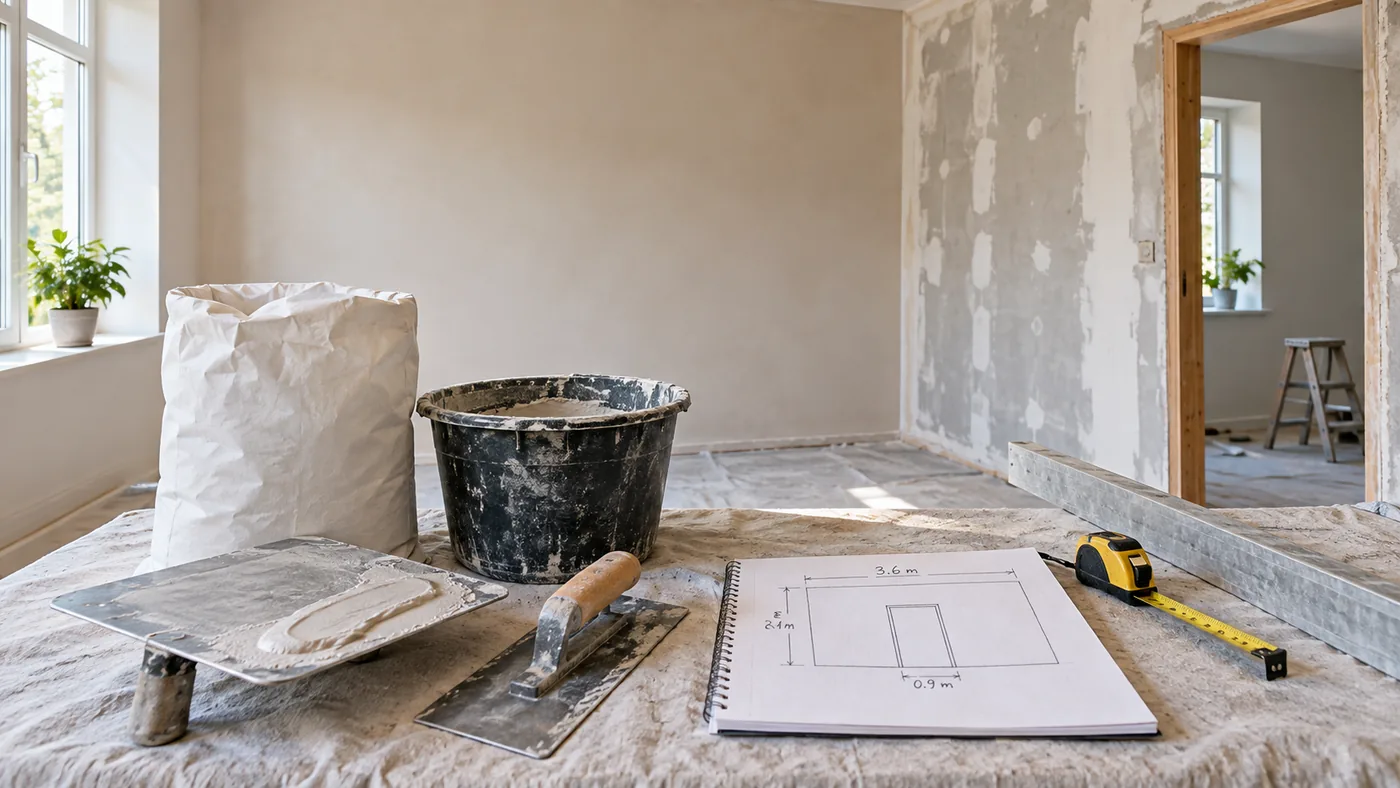
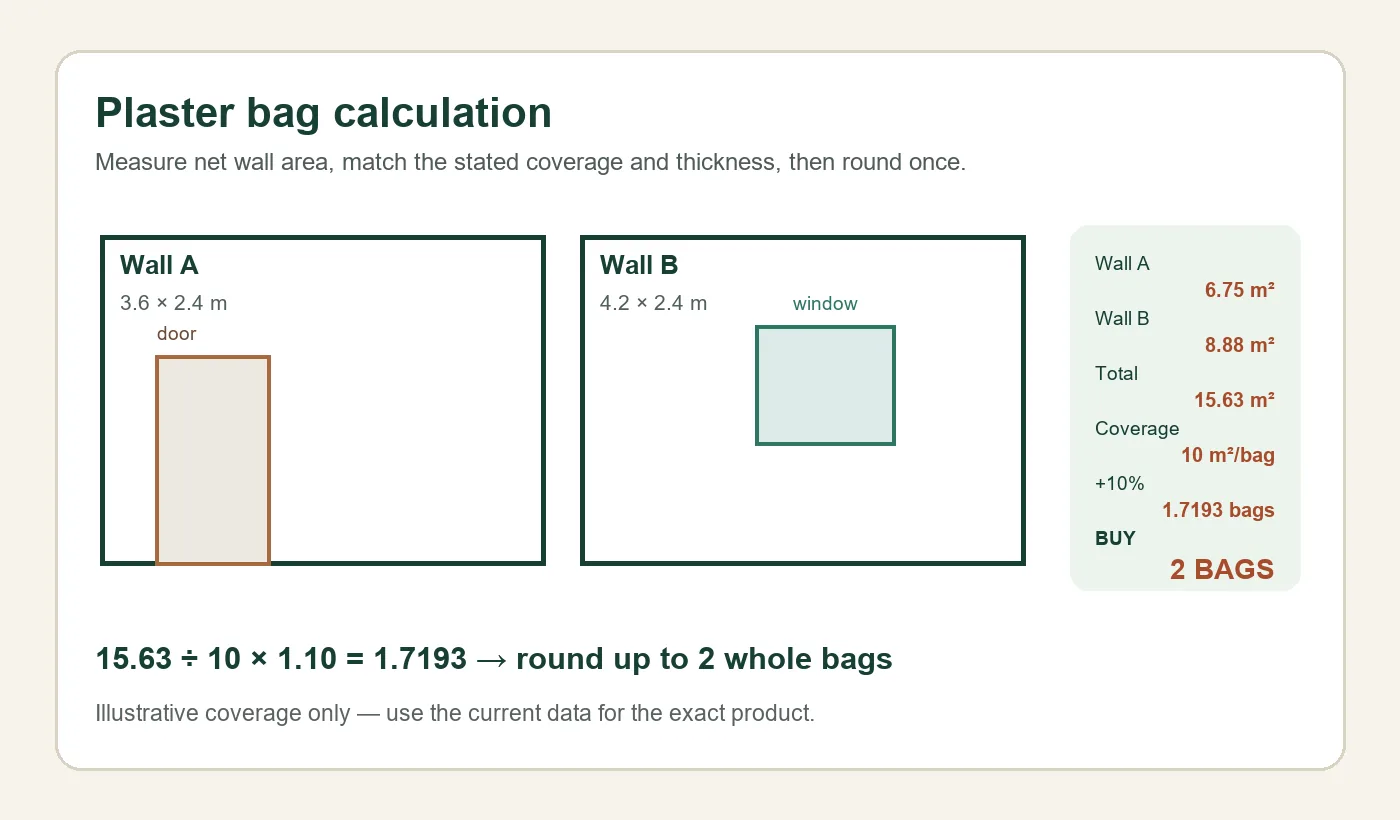
Consider two metric walls that will receive a hypothetical finish plaster at an average 2-millimeter system thickness. Wall A is 3.6 by 2.4 meters with a 0.9-by-2.1-meter door. Wall B is 4.2 by 2.4 meters with a 1.2-by-1-meter window.
| Surface | Calculation | Net area |
|---|---|---|
| Wall A | (3.6 × 2.4) − (0.9 × 2.1) | 6.75 m² |
| Wall B | (4.2 × 2.4) − (1.2 × 1.0) | 8.88 m² |
| Total | 6.75 + 8.88 | 15.63 m² |
For illustration, suppose the exact product data says one bag covers 10 square meters at 2 millimeters. The surfaces need 15.63 ÷ 10 = 1.563 bags before extra. Add a chosen 10% allowance: 1.563 × 1.10 = 1.7193. Round up once to two whole bags.
The example coverage is deliberately hypothetical. Replace it with the current value for the exact product you intend to use. If its stated coverage is 8 square meters rather than 10, the same walls need 15.63 ÷ 8 × 1.10 = 2.1491, which rounds to three bags. A small difference on the label changes the order.
What if the average thickness is 3 millimeters?
Using the same hypothetical reference—10 square meters at 2 millimeters—the thickness factor is 3 ÷ 2 = 1.5. The requirement becomes 15.63 ÷ 10 × 1.5 × 1.10 = 2.57895 bags, which rounds to three. This scaling is a quantity comparison, not approval to apply that product at 3 millimeters. First confirm the permitted thickness and coat arrangement.
That distinction prevents a common mistake: changing the thickness in the calculation without checking whether the product can be used that way. If the wall needs a thicker correction than the finish product permits, the answer may be a specified backing layer or repair method, not more finish plaster.
Preparation affects the job even when it does not appear in the formula
The square-meter calculation cannot see dust, high suction, glossy paint, loose plaster, cracks or movement. These conditions can affect preparation, bonding and application. Record them during the survey. Keep primers, bonding agents, mesh and repairs as separate line items with their own product coverage.
For a plasterboard room, first verify the board quantity and system with the drywall sheet guide and drywall calculator. Do not count a full skim and joint compound for the same finish unless the specified process truly requires both.
On existing buildings, pause before sanding or disturbing an unknown coating. Age alone does not identify a material. Arrange appropriate assessment where asbestos, lead paint or another hazard could be present, and follow local requirements.
Drying time is not calculated from bag count
Two bags do not imply twice the drying time of one. Drying depends on the material, applied thickness, background, temperature, humidity and ventilation. Follow the product instructions before decoration. A surface that looks pale can still have local damp areas; rushing the paint schedule can create a separate failure after a correct material order.
Build an order someone else can check
Save the calculator result with the product name, pack size, coverage statement, reference thickness and date checked. Prices and formulations can change. If you have two products, show them on separate lines. Add bead, mesh, primer, protection, access equipment and disposal where relevant instead of hiding everything inside the plaster bag price.
For professional quotes, distinguish working time from elapsed time. A coat may require a wait before the next operation, but that wait is not always paid labour for the full crew. Include travel, setup and cleanup deliberately. If you apply markup, review both the selling price and resulting gross margin before presenting the quote.
When comparing suppliers, use total usable coverage, not bag price alone. A cheaper bag can cost more per square meter if its stated coverage is lower. Delivery fees and minimum orders may outweigh a small unit-price difference.
Final survey and order checklist
- The exact plaster or compound system has been selected for the background.
- Walls, ceilings, reveals and repairs are measured without overlap.
- Doors and windows are deducted consistently.
- Each product layer has its own thickness and coverage.
- The calculator method matches the wording on the current data sheet.
- The extra percentage is deliberate and is not covering an unmeasured area.
- Existing stock is matching, usable and complete.
- Primer, bead, mesh, protection and access are separate line items.
- Whole packs are rounded once after the combined requirement is calculated.
- The saved estimate includes assumptions someone else can review.
Plaster and skim quantity FAQs
How do I calculate plaster for a wall?
Multiply wall length by height, subtract openings, then divide the net area by the product’s stated coverage at the matching thickness. Adjust for a different specified thickness only as the data allows, add a justified allowance and round up to whole packs.
Should I use square feet or square meters?
Use the unit printed in the product coverage and enter measurements in the matching calculator mode. Converting is possible, but mixing square feet, square meters, inches and millimeters in one manual formula is a common source of large errors.
Does a two-coat skim mean I double the bag count?
Not automatically. Some coverage statements describe the completed two-coat application at a total thickness. Others describe one layer. Follow the exact product wording and enter the total specified consumption once.
Can I use one average thickness for a badly uneven wall?
Only when that average is based on enough measurements and the chosen product is suitable across the range. For distinct deep and shallow sections, split the wall into zones. A thin finish coat is not a general-purpose deep filler.
Why did the calculator round 1.1 bags to two?
You normally cannot purchase a tenth of a bag as usable sealed stock. The tool rounds the combined requirement up to whole packs so the shopping list can actually be bought.
Should I deduct doors and windows?
Deduct openings that will not receive plaster, then include reveals or returns separately if they matter. For very small openings, the practical saving may be absorbed by normal losses, but document the method you use.
Is joint compound the same as finish plaster?
No. Products, application methods and coverage conventions vary. North American joint compound, veneer plaster and UK finish plaster should not be treated as interchangeable simply because each can create a smooth surface.
How much extra plaster should I allow?
There is no universal percentage. Base it on the measured surface, background, number of small areas, mixing and application losses and your experience with the exact product. Do not use a large allowance to avoid surveying the wall.
Can the calculator tell me whether a wall needs bonding or primer?
No. It can estimate a specified product once you enter its coverage. Suitability and preparation depend on the background and the chosen system.
Can I paint as soon as the calculated plaster is used?
The bag count says nothing about readiness for decoration. Follow the manufacturer’s drying and preparation instructions, accounting for thickness, background and site conditions.
Ready to estimate your surfaces? Open the plastering and skimming calculator, enter each wall and ceiling from your sketch, and save the result with the product coverage statement you used.