
Paint is sold by volume, but the job is measured in surface area and coats. That gap is where most bad estimates begin. A room described as “12 by 14 feet” has only 168 square feet of floor, yet its four walls may need more than 800 square feet of paint application once two coats are counted.
Measure each surface, subtract only the openings you intend to exclude, multiply by the planned coats, and divide by the exact product’s stated coverage. The free painting and decorating calculator keeps wall, ceiling and primer quantities separate and can also estimate labor, materials and a customer price.
This guide is a quantity-planning method, not a promise that a particular paint will cover in a fixed number of coats. Surface condition, color change, texture and application all matter. Use the current label or technical data sheet for the paint you will actually buy.
Measure walls, ceilings and extras as separate jobs
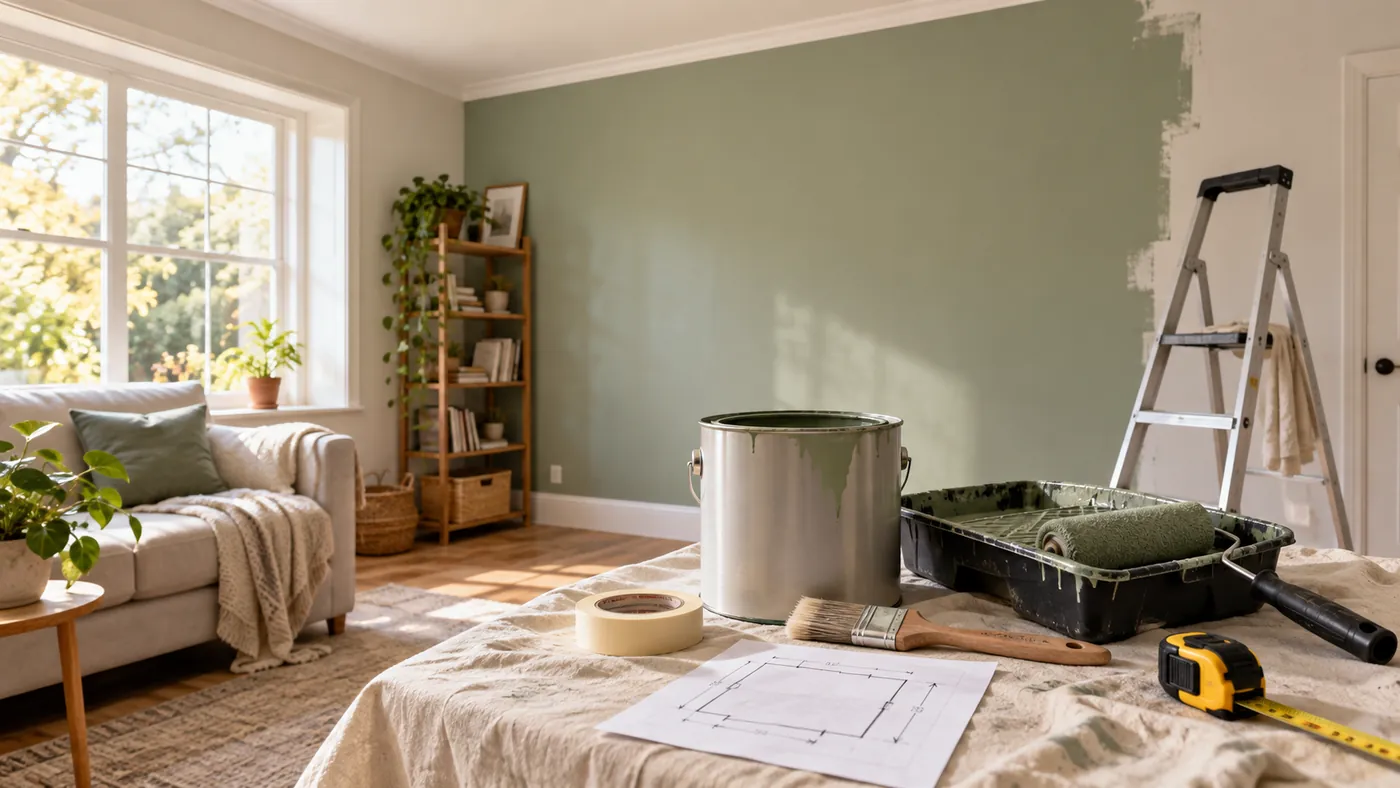
Sketch the room before opening the calculator. Label length, width and height, then list doors and windows with their real dimensions. For a rectangular room, gross wall area is twice the length plus twice the width, multiplied by height. Ceiling area is length multiplied by width. A sloped or vaulted ceiling needs its actual surface measurement rather than the floor area.
Keep surfaces that receive different products separate. Walls may use an eggshell finish, the ceiling a flat paint, and new plaster a dedicated primer or mist system. Doors, trim, cabinets and paneling belong in the additional-area section when they are part of the job. Combining them into one number can hide a shortfall in one product and a surplus in another.
When should you deduct doors and windows?
Deduct large openings when they are not painted and when you have measured them. For small openings, some decorators leave the gross area intact because cutting-in, roller loading and residual paint consume part of the apparent saving. Either method can be reasonable; the important part is to use it consistently and record the choice.
Do not deduct a door if its face will be painted with the same product. If it receives a different enamel, subtract it from the wall and add its paintable faces to the additional-area calculation. Measure deep reveals separately when their area is material to the estimate.
How to use the painting and decorating calculator
1. Set units, currency and room dimensions
Choose Metric for meters and square meters, or Imperial for feet and square feet. Paint volume is reported in liters in both modes. For a US label stated in square feet per gallon, convert the spreading rate to square feet per liter before entering it; one US gallon is approximately 3.785 liters. Enter the room length, width and height from your sketch, not from a property listing.
2. Enter real openings or leave deductions off
Add the number and average dimensions of doors and windows if you want them deducted. When openings vary greatly, calculate their individual areas on the sketch and use an equivalent total only after checking it. Turn the deduction option off when your deliberate estimating method retains them.
3. Give each coating its own coats and coverage
Enter wall coats and the wall paint’s stated coverage. Repeat that process for ceiling paint and primer. A “paint and primer” marketing description does not automatically mean a separate primer is never needed; follow the label for the actual substrate and color change. Leave unused sections at zero rather than inventing a coverage.
Manufacturer calculators show why these inputs matter. Sherwin-Williams’ paint calculator guidance gives a typical range of 350–400 square feet per gallon and warns that texture and desired coverage change the amount. Behr’s coverage calculator likewise describes its result as an estimate and separates walls, ceiling, doors and trim. Use the figure for your selected product rather than treating either range as universal.
4. Add only genuine extra painting area
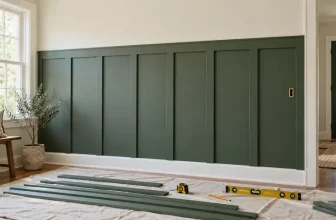
Use the extra-area field for measured surfaces outside the room formula: a feature panel, both faces of a door, built-in shelves or a short hall wall. Enter its coats, coverage and price independently. Do not use it as a vague contingency; the allowance control is the clearer place for that.
5. Review quantity before labor and markup
Calculate the physical requirement first. Confirm that gross wall area, opening deductions, ceiling area and total application area match the sketch. Only then add paint prices, productivity, preparation hours, sundries, labor rate, markup and tax. A polished price cannot repair a wrong area.
Worked example: one room, two wall coats and one ceiling coat
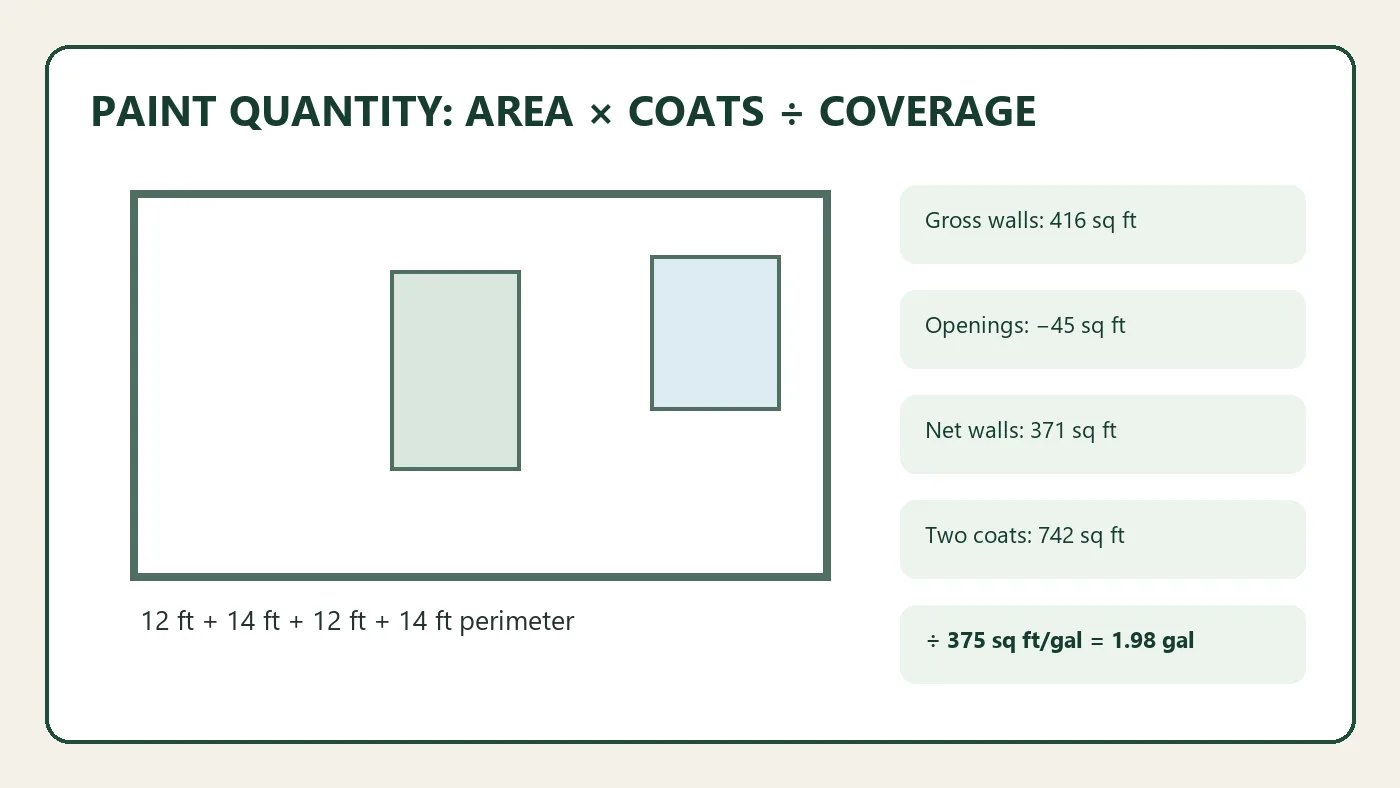
Consider a 12-by-14-foot bedroom with an 8-foot ceiling. It has one 3-by-7-foot door and two 3-by-4-foot windows. The walls receive two coats. The ceiling receives one coat. For this checked example, the selected wall paint states 375 square feet per gallon and the ceiling paint states 400 square feet per gallon.
| Part | Calculation | Result |
|---|---|---|
| Gross wall area | 2 × (12 + 14) × 8 | 416 sq ft |
| Openings | (3 × 7) + 2 × (3 × 4) | 45 sq ft |
| Net wall area | 416 − 45 | 371 sq ft |
| Two wall coats | 371 × 2 | 742 sq ft of application |
| Wall paint | 742 ÷ 375 | 1.98 gal |
| Ceiling paint | (12 × 14) ÷ 400 | 0.42 gal |
To reproduce this US example in the live calculator: select Imperial, then enter about 99.1 square feet per liter for the wall paint (375 ÷ 3.785) and 105.7 square feet per liter for the ceiling paint (400 ÷ 3.785). The result is about 7.49 liters and 1.59 liters, equivalent to 1.98 and 0.42 US gallons.
The arithmetic points to about two gallons of wall paint and 0.42 gallon of ceiling paint before a project-specific allowance. You would then compare available container sizes. If ceiling paint is sold by the gallon and quart, two quarts may cover the calculated amount with some practical margin; availability and touch-up needs may make a full gallon more sensible. Record that purchasing decision separately from the raw requirement.
Now change the wall coverage to 300 square feet per gallon while leaving everything else the same. The walls require 742 ÷ 300 = 2.47 gallons. That no longer fits two one-gallon cans. This simple check shows why copying a generic “one gallon per room” rule can fail.
Metric cross-check
The same method works in metric. A room 3.6 by 4.2 meters and 2.4 meters high has 37.44 square meters of gross wall. Subtract a 0.9-by-2.1-meter door and two 0.9-by-1.2-meter windows to get 33.39 square meters. Two coats create 66.78 square meters of application. At a stated 12 square meters per liter, the unrounded requirement is 5.57 liters before allowance.
Coverage, hiding and coats answer different questions
Coverage is the area a stated volume can coat at the intended film thickness. Hiding describes how well the coating obscures the background. A paint may physically spread over an area without fully hiding a strong color change. That is why the number of planned coats and the coverage per coat must stay as separate inputs.
Porous new material, rough texture and heavy roller loading can reduce practical coverage. A dramatic color change may need another coat even if the surface is smooth. Test a representative area and follow preparation instructions. Do not quietly lower the spreading rate to compensate for every uncertainty; document the specific reason for any conservative assumption.
Primer is its own quantity
Primer, stain blocker and mist systems can have different coverage and pack sizes from finish paint. Calculate them independently. If only one repaired wall needs primer, enter that measured area rather than priming the mathematical area of the entire room. For newly plastered surfaces, confirm that the selected coating system is appropriate and that the plaster is ready before painting. The plaster quantity guide explains why material amount does not determine drying time.
Use a sample area to challenge the estimate
A small test area can reveal more than a neat spreadsheet. Apply the selected system to a representative patch using the intended roller or brush, then inspect hiding, adhesion and surface texture after the stated drying time. If the test requires another coat, update the coat count rather than disguising the change inside a large waste percentage. If the surface absorbs unevenly, stop and resolve preparation before buying all the finish paint.
Keep the test result with the estimate: product, base, color, application method, surface and date. This is especially useful on repaints where repaired patches and old coatings behave differently. The record turns “it should cover” into a visible assumption that another person can check.
Turn the result into an order you can defend
First save the raw liters or gallons. Then list the container combination you intend to buy. Consider whether the same batch will be needed for later touch-ups, whether unopened cans can be returned, and whether a larger container is actually cheaper after waste. Do not round every room up independently when several rooms use the same paint; combine their unrounded requirements, then round once.
Keep a photo of the label or data sheet with the estimate. Note color, sheen, base, batch information and date purchased. Price sundries separately: filler, caulk, masking materials, abrasives, roller sleeves, liners and protection can matter more than a small difference in paint quantity.
For a customer quote, separate productive rolling time from preparation, cutting-in, drying gaps, moving furniture and cleanup. The calculator can apply productivity and an hourly rate, but your survey must decide the realistic hours. If the room has damaged walls, price the repair scope rather than burying it in an optimistic painting rate.
Final paint-order checklist
- Sketch dimensions have been measured on site.
- Walls, ceiling, trim and extras are assigned to the correct products.
- Opening deductions match what will actually remain unpainted.
- Coat counts follow the selected product and test area.
- Coverage comes from the current label or data sheet.
- Primer and finish quantities are separate.
- The allowance has a stated reason.
- Combined requirements are rounded only after totals are known.
- Container sizes, color, sheen and batch are recorded.
- Labor, sundries and tax are added after the material check.
Paint quantity FAQs
How much paint do I need for a 12-by-12 room?
The floor size is not enough. You need wall height, openings, coats and the product coverage. With 8-foot walls, the gross wall area is 384 square feet before deductions; two coats mean 768 square feet of application.
Should I count the floor area when estimating wall paint?
No. Floor area does not describe wall area. Use the room perimeter multiplied by wall height, then handle openings and coats.
Do I multiply by coats before or after deducting windows?
Calculate the net paintable surface first, then multiply that net area by the number of coats receiving the same product.
How many square feet does a gallon cover?
Use the exact product’s current figure. Some manufacturer guidance cites a typical range near 350–400 square feet per gallon, but texture, substrate, application and product specification can change it.
Should I buy exactly the calculator result?
Use the result as the unrounded requirement, then compare actual container sizes and a justified allowance. Keep the arithmetic and purchasing decision visible.
Does paint-and-primer eliminate primer?
Not in every situation. Substrate condition, stains, adhesion and color change may still call for a separate primer. Follow the product instructions.
Can I combine leftover paint from another room?
Only after confirming product, color, sheen, condition and compatibility. Count usable matching stock explicitly rather than assuming every partial can is available.
Why did I use more paint than estimated?
Common reasons include rough or porous surfaces, lower real spreading rate, extra coats, unmeasured areas and material left in tools or containers. Compare the saved assumptions with the completed work.
Does the calculator give a guaranteed quote?
No. It calculates from your inputs. Site condition, access, repair work and productivity still need professional judgment.
Can I use the tool outside the UK?
Yes. Select suitable units and currency, enter local tax if relevant, and use the coverage and price for products sold in your market.
Ready to check the order? Open the painting and decorating calculator, reproduce the example, then replace every input with your measured room and selected products.