
Floor material quantities come from volume: area multiplied by depth. A small mistake in depth affects the entire floor, so check that measurement before comparing bag prices. An extra quarter inch across a room is real material, even if it looks insignificant on a tape measure.
The floor screed calculator provides traditional, bagged and ready-mix estimating methods. US readers may be planning a specified mortar bed or floor underlayment rather than a product sold as screed. Use the method and yield matching the actual product; self-leveling underlayment, dry-pack mortar and traditional screed aren’t interchangeable just because they all go on a floor.
Establish the depth before calculating the order
Confirm the floor assembly, finished levels and product limits with the project specification and manufacturer. The calculator accepts a thickness, but it doesn’t decide whether that thickness is suitable for a bonded, unbonded, floating or heated floor.
Measure from a consistent level reference and identify high and low spots. One depth recorded at a doorway may not describe the middle of the room. If areas need different specified depths, enter them separately so the volume reflects that difference.
For a deliberately sloping or irregular bed, use a checked geometric takeoff or a suitable measured average for each defined area. Don’t assume a single center measurement gives the average. The simple rectangular example below uses a uniform thickness and doesn’t design a shower slope.
Calculate a small room in cubic feet first
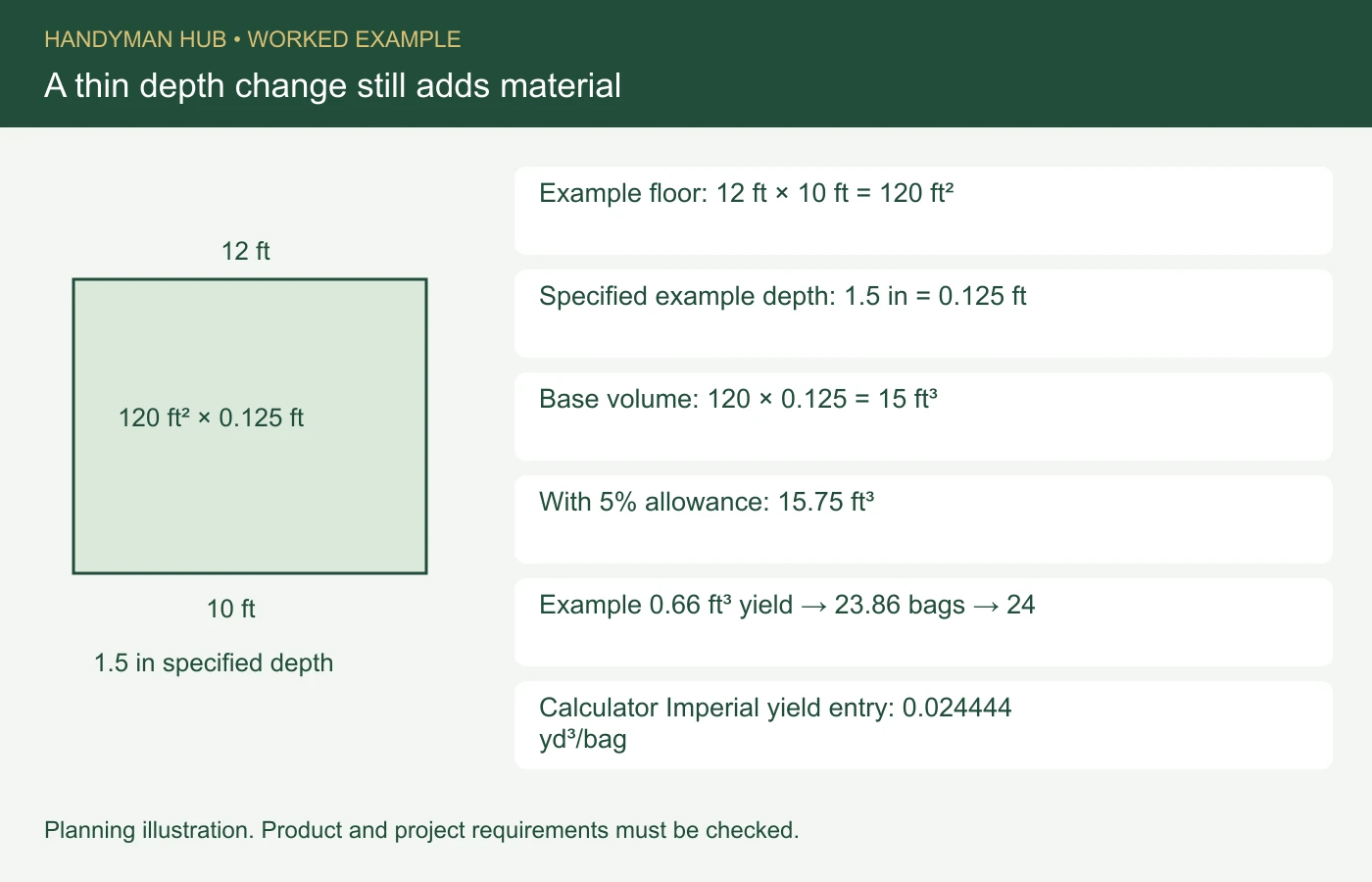
Take a 12-by-10-foot floor at an illustrative specified thickness of 1.5 inches. The area is 120 square feet. Convert the depth to feet: 1.5 ÷ 12 = 0.125 feet. Multiply 120 by 0.125 to get 15 cubic feet of finished material.
For this ordering example, add 5%: 15 × 1.05 = 15.75 cubic feet. In cubic yards, divide by 27, giving about 0.5833 cubic yards. The allowance is illustrative; actual loss and extra requirements depend on the job and supplier.
Now compare a depth of 1.75 inches over the same area. That adds 120 × 0.25 ÷ 12 = 2.5 cubic feet before allowance. The floor area hasn’t changed at all. This is why measuring levels usually matters more than adding another decimal place to the room’s length.
Use the named product’s yield
A dry bag’s weight doesn’t tell you its installed volume without further information. Use the manufacturer’s mixed yield, or its coverage at a stated thickness, rather than borrowing a yield from a different mortar or concrete product.
The cited QUIKRETE Floor Mud technical sheet gives an approximate yield of 0.66 cubic feet for an 80-pound bag. Using that published yield purely for this quantity example, 15.75 ÷ 0.66 = about 23.86 bags, rounded up to 24. Product suitability and installation details must still be confirmed for the actual floor.
Twenty-four 80-pound bags represent 1,920 pounds of purchased dry material. That number is useful when discussing delivery and handling. It is not a structural loading assessment, and it doesn’t mean the bags should be stacked together at one point on an existing floor.
Watch the calculator’s cubic-yard field
In Imperial mode, the calculator displays its yield-per-bag entry in cubic yards. A manufacturer may publish cubic feet. Divide 0.66 by 27 to enter approximately 0.024444 cubic yards per bag; entering 0.66 directly would make the assumed yield 27 times too large.
To reproduce the live result, select Imperial and Premixed/Bagged Screed. Enter a rectangular area 12 by 10 feet, thickness 1.5 inches, waste 5%, bag weight 80 pounds and yield 0.024444444 cubic yards per bag. The result shows about 0.556 cubic yards before allowance, 0.583 after allowance and 24 whole bags.
If your manufacturer instead publishes coverage at a stated depth, use that mode and enter both figures. A coverage number without its depth is incomplete. Keep the source sheet with the saved estimate so the unit conversion can be checked later.
Choose the purchase method that matches the delivery
Bagged material rounds up to complete bags. A ready-mix or loose delivery may have a minimum order and order increment. Those are supplier terms, not properties of the room, so get them confirmed before treating the theoretical volume as the invoice quantity.
The traditional sand-and-cement method uses entered mix assumptions. It should not replace manufacturer yield for a proprietary bagged product. Similarly, a convenient mix ratio in a calculator menu isn’t a specification for the floor you are building.
If you are comparing two quotes, make sure both use the same scope and depth. One may include pumping, delivery or a minimum charge while another gives only a unit material rate. Ask what happens if the measured volume changes after preparation exposes an uneven base.
Keep preparation and follow-on work visible
Include the specified preparation, bonding or separation materials, movement details and any other assembly components in a separate list. The Floor Mud product page links to its technical information; use the current instructions for the actual product rather than treating this worked order as an application recipe.
Coordinate separately specified insulation and membrane roll quantities with the floor design. For a wet area, the waterproofing checklist addresses another layer with different measurements and details.
Before placing the order, check three things together: the measured volume, the product’s stated yield and the supplier’s purchase unit. Save the floor estimate with those assumptions. If a dimension or specification changes, you can then revise the number without starting the whole takeoff again.
Featured image: original concept illustration, not a completed Handyman Hub customer project.