
Thirty feet of finished lumber does not necessarily mean buying thirty feet. The store sells particular lengths, a blade removes material, and some parts must come from one unbroken board. A useful shopping list keeps those constraints beside the total footage.
This guide walks through two small examples: a continuous run and five separate parts. Use the lumber calculator alongside it to compare stock lengths, allowances and the purchase cost.
Write the cut list before the shopping list
Give each part a finished length, quantity and actual cross-section. Group pieces only when their species, grade, treatment, appearance and dimensions are interchangeable. An attractive offcut is not useful if it is the wrong thickness or unsuitable for the intended exposure.
Record where a part must remain continuous. That matters for a long trim piece with no desired seam, and it is essential for structural members whose joints and supports belong to the design. The calculator’s continuous-run mode does not authorize splicing a joist or beam.
Next, check the lengths your supplier actually stocks. An online listing may show a nominal board size while your layout needs the finished face width. Measure representative stock and check the product description before treating a nominal two-by-four as a 2-inch by 4-inch finished rectangle.
Example 1: a 30-foot run using 8-foot boards
Suppose a nonstructural run can use separate lengths, and your checked plan needs 30 linear feet. Enter continuous/run lengths, 30 feet per run, one run, 8-foot stock and a 10% allowance. These are estimating inputs, not recommended joints or universal waste rates.
| Stage | Quantity |
|---|---|
| Finished length | 30 ft |
| Entered allowance | 3 ft |
| Target before stock rounding | 33 ft |
| Whole 8-foot boards | 5 |
| Purchased length | 40 ft |
The live tool returns five boards. Four would provide only 32 feet, below the 33-foot target. At an illustrative $6 per board, the material line is $30 before delivery, tax or other costs. Replace that price with your supplier’s quote.
The ten feet between purchased and finished length is not all the entered 10% allowance. Three feet came from the allowance and seven more from rounding to whole boards. Keep both visible when deciding whether a different stock length is worth comparing.
Example 2: why total footage can undercount separate parts
Now the job needs five identical 5-foot parts, each in one piece. That is only 25 finished feet. Dividing 25 by 8 and rounding up suggests four boards, but four boards cannot produce five unbroken 5-foot parts.
Each 8-foot board accommodates one such part. Select individual identical pieces, enter 5 feet, five pieces, 8-foot stock and zero allowance. The checked result is five boards: 40 purchased feet for 25 finished feet. The nominal 3-foot remainder per board becomes slightly shorter after cutting and end preparation.
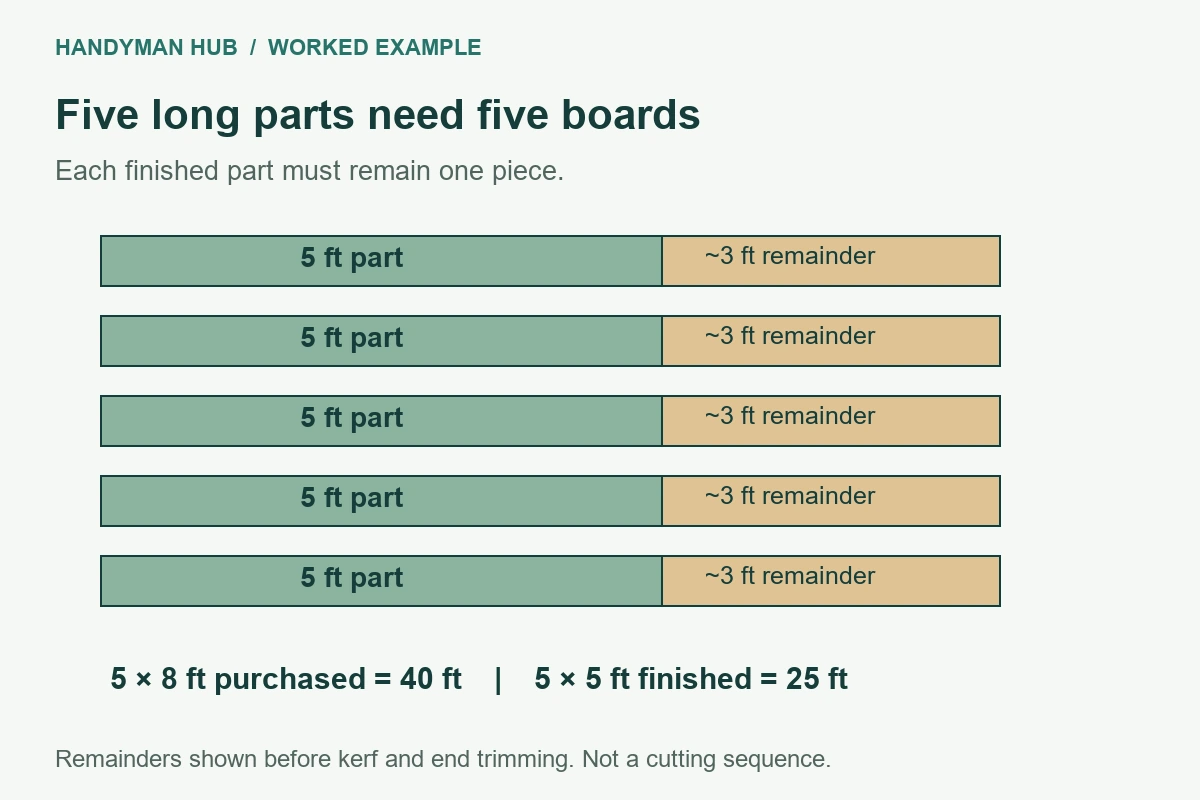
This is why a general waste percentage cannot replace a cutting plan. A pile of short offcuts cannot supply one missing long piece. For mixed part lengths, sketch which pieces fit each board with space for every cut; the identical-piece mode is not a mixed-length optimizer.
Account for kerf, trimming and defects once
A practical board layout needs room for the saw’s actual cut width, any required end trimming and defects that must be removed. If two finished pieces exactly equal a stock length, there is no room left for the separating cut. Buying a little extra overall does not make that particular arrangement fit.
Mark the allowance basis in your notes. If your part lengths already include trimming, do not silently add the same trimming again. Conversely, a purchasing allowance should not be used to shorten a specified finished part. Keep reusable offcuts labeled by dimensions and material so they can be checked for a later task.
Linear feet and board feet answer different questions
Linear feet describe length. Board feet describe wood volume: Woodworkers Source explains the board-foot unit as 144 cubic inches, commonly used for random-width and random-length hardwood.
For the first example, entering a 3.5-inch width and 1.5-inch thickness gives 17.5 board feet across the 40 purchased linear feet: 3.5 × 1.5 × 40 ÷ 12. That is volume from the dimensions entered. A lumberyard may use a nominal thickness or another documented tally basis for billing, so confirm how its quoted board-foot price applies.
Turn the estimate into a checked order
Before buying, compare the actual bundle: board count, stock length, usable cross-section and delivered price. Include collection or delivery only once, and decide whether remaining stock has a realistic future use. A lower price per foot can still produce a more expensive purchase when the lengths fit badly.
If the job is a deck, start with the deck board direction and cut-allowance guide before settling the cut list. For panels, the sheet cutting planner handles two-dimensional layouts. For decorative slats, work out the spacing and member count first, then price the lumber those parts require.