

A handyman quote needs to cover the whole job: your time, any helpers, materials, travel, direct expenses and a contribution toward running the business. Then you can apply the markup you’ve chosen. Starting with an hourly rate alone leaves too many ways for a small repair to become an unprofitable afternoon.
This guide builds a hypothetical $330 pre-tax quote from individual inputs, explains what that figure includes, and shows what changes when the job takes longer. The numbers are an arithmetic example, not a recommended local rate or a promise of profit.
Use the free Handyman Hub job price calculator alongside the example. Choose USD before entering dollar amounts. Changing the currency label doesn’t convert an existing estimate.
Write the scope before choosing a price
“Repair the door” is too vague to estimate consistently. “Adjust the existing latch, replace two agreed hinges, test operation and remove the old hardware” gives you something to price. Record the room or item, the agreed finish, who supplies parts and what you’ll do if the original diagnosis is wrong.
For a small job, a useful scope can fit into five lines. Include the work, materials, access assumptions, exclusions and completion standard. If concealed damage would change the work, explain how you’ll agree a revised price before proceeding. Don’t quietly price a known problem as though it were an unlikely surprise.
Separate working time from the appointment window. A two-hour repair might also require collection, unloading, setup, cleanup and a return visit. Decide where those costs belong in your estimate. You can charge for time or recover some activities through your pricing structure, but you need to account for them somewhere.
Choose a consistent basis for labor and overhead
The calculator’s own-labor field is the hourly amount you want included for your work. Know whether that amount is just labor compensation or already contains business overhead and profit. Entering a fully loaded selling rate and then adding the same overhead and markup again can inflate the quote unintentionally.
Use the hourly and day rate calculator to explore the assumptions behind a rate. Keep a note of which expenses it includes. For helpers, use the additional-worker rows rather than hiding their cost inside your own hours. A helper paid for four hours is still a cost even if the customer sees one person handling the final repair.
Your business also has expenses between jobs: insurance, bookkeeping, equipment replacement, software and time spent quoting. An overhead percentage is an allowance toward those expenses, not evidence that they have all been recovered. Michael Stone’s explanation of calculating your own markup makes a useful point: the appropriate figure depends on the business’s numbers, not a universal industry percentage.
A worked $330 quote
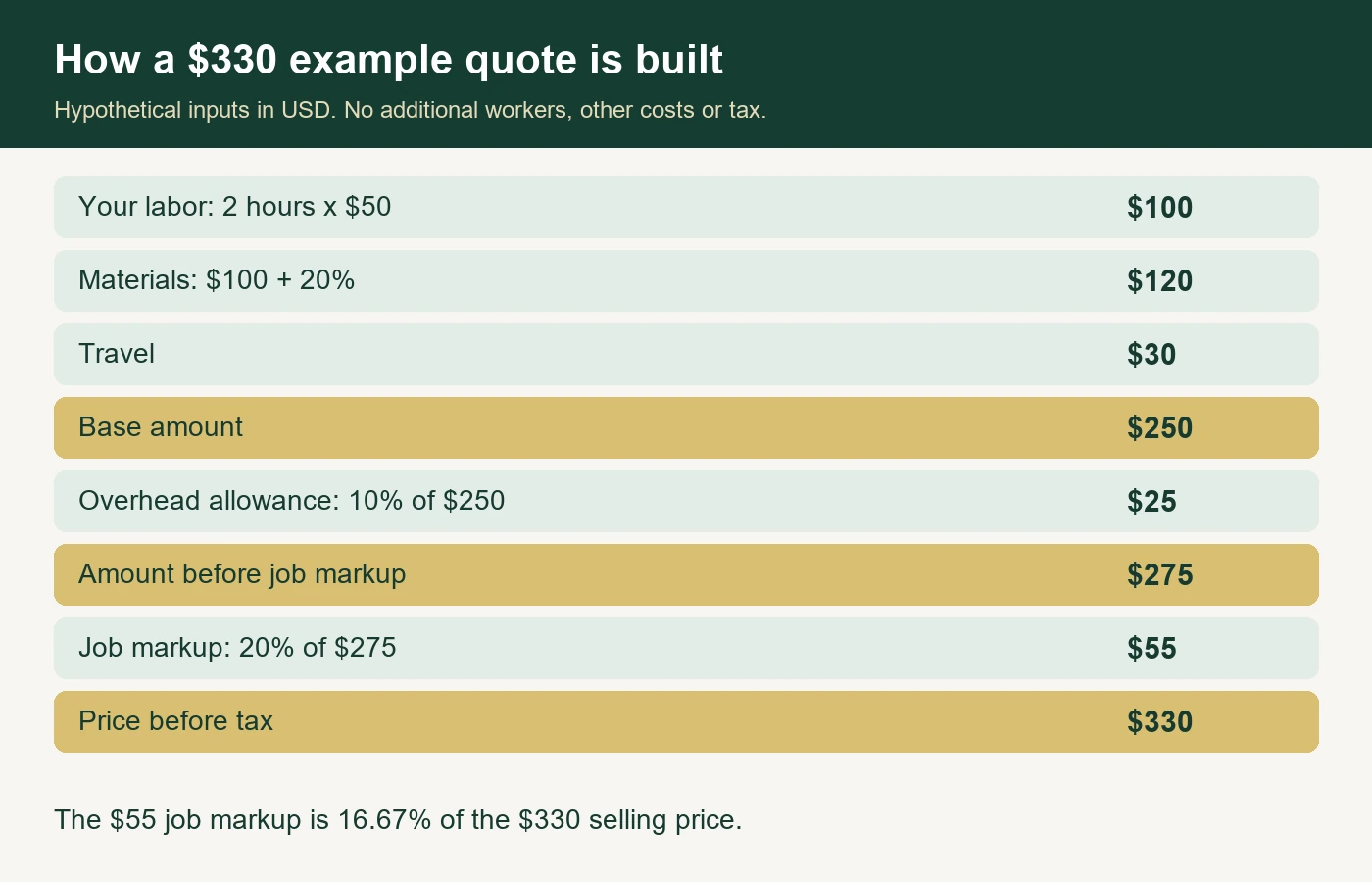
For this example, assume two hours of your labor at $50 per hour, $100 of purchased materials and $30 of travel costs. There are no additional workers or other direct costs. Apply a 20% material markup, a 10% overhead allowance and a 20% job markup. Set transaction tax to zero solely to isolate the pricing arithmetic.
| Step | Calculation | Amount |
|---|---|---|
| Your labor | 2 × $50 | $100 |
| Materials charged | $100 × 1.20 | $120 |
| Travel | Entered cost | $30 |
| Base amount | $100 + $120 + $30 | $250 |
| Overhead allowance | $250 × 10% | $25 |
| Before job markup | $250 + $25 | $275 |
| Job markup | $275 × 20% | $55 |
| Price before tax | $275 + $55 | $330 |
Those inputs were checked in the live calculator. Notice the order: material markup is applied first; overhead is calculated on the resulting base amount; job markup follows. Adding all three percentages together and applying them once would produce a different answer.
The $55 job markup isn’t necessarily the job’s net profit. Actual costs may differ from estimates, and your overhead allowance may recover more or less than the job’s share of business expenses. Keep the estimate for comparison with the finished job rather than treating the label on the result as an accounting statement.
Why 20% markup is not 20% margin
Markup divides the added amount by its cost basis. Margin divides the remaining amount by selling price. In the final step above, $55 ÷ $275 is 20% markup, while $55 ÷ $330 is about 16.67% of the selling price.
If the goal were a 20% margin on that same $275 basis, the arithmetic would be $275 ÷ 0.80 = $343.75. That is a comparison of formulas, not a recommendation to use that margin. Procore’s construction markup and margin guide explains the different denominators. In practice, label your cost basis before discussing either percentage.
Test the assumption most likely to change
Suppose the example needs three labor hours rather than two. Labor becomes $150. With everything else unchanged, the base becomes $300, overhead becomes $30 and job markup becomes $66. The revised pre-tax price is $396. The extra $50 labor input changes the quote by $66 because the later allowances also apply.
This is why “I’ll add another $50 if needed” may not preserve the original pricing approach. Before quoting, test a realistic longer-duration scenario. Use the project labor and duration calculator when several workers or work stages make time harder to track.
For uncertain parts, list the assumption instead of silently inflating every line. A specified replacement fitting, a disposal allowance and a clear rule for additional work are easier to discuss than one unexplained contingency figure. Keep an actual supplier price separate from an allowance that still needs checking.
Check materials, travel and tax before sending
Material markup can contribute toward sourcing, handling and supplying products. If collection time is already charged elsewhere, be clear about the purpose of each line. The same applies to travel: avoid recovering the identical fuel expense once as a direct job cost and again as an itemized travel charge without intending to.
The calculator applies its transaction-tax field across the calculated pre-tax price. It doesn’t determine which parts of a US job are taxable. If your applicable treatment taxes only selected materials or services, don’t use one blanket percentage as a substitute for that treatment. Confirm the correct invoice calculation for your location and work type. Income tax is outside this field.
Read the finished quote as the customer will. They should understand the agreed work, what is supplied, the price, any applicable tax, payment terms and the process for changes. Keep the internal calculation detailed even if the customer-facing description is concise.
Close the loop after the job
Record actual hours, receipts, helper costs and travel while they’re still easy to recall. Then use the job profit calculator with a consistent cost scope to compare the result with your estimate. A pattern of extra collection trips suggests a different fix from a pattern of underestimated installation hours.
Start your next quote with that evidence. One unexpectedly difficult repair doesn’t establish a new standard rate, but repeated differences tell you which assumption needs attention.
Build your own itemized job price →
Featured artwork is an original concept illustration. Dollar amounts are hypothetical examples; no customer project or professional review is implied.


[…] Handyman Job Pricing […]
[…] Handyman Job Pricing […]