
A cartridge can cover a surprisingly long hairline bead and disappear almost immediately into a wide, deep joint. That is why “How many tubes do I need?” cannot be answered from length alone. The useful calculation combines the total run length with the finished cross-section of the sealant, then allows for starts, stops and material left in the nozzle.
This guide shows you how to measure the job, distinguish a filled joint from a corner fillet, use the free sealant, silicone and caulk calculator, and turn its result into a sensible shopping list. It works for metric and US customary measurements and for silicone, acrylic caulk, hybrid sealant and similar cartridge products. Product choice and joint design still come from the sealant manufacturer: the calculator estimates the quantity for the joint you specify.
The short answer
For a rectangular joint, volume in millilitres is length (m) × width (mm) × depth (mm). A right-triangular corner fillet uses half that cross-sectional area. Divide the adjusted volume by the usable cartridge size and always round up to a whole cartridge. If the product data sheet gives coverage for your exact joint size, use that figure instead.
Why joint shape changes the answer
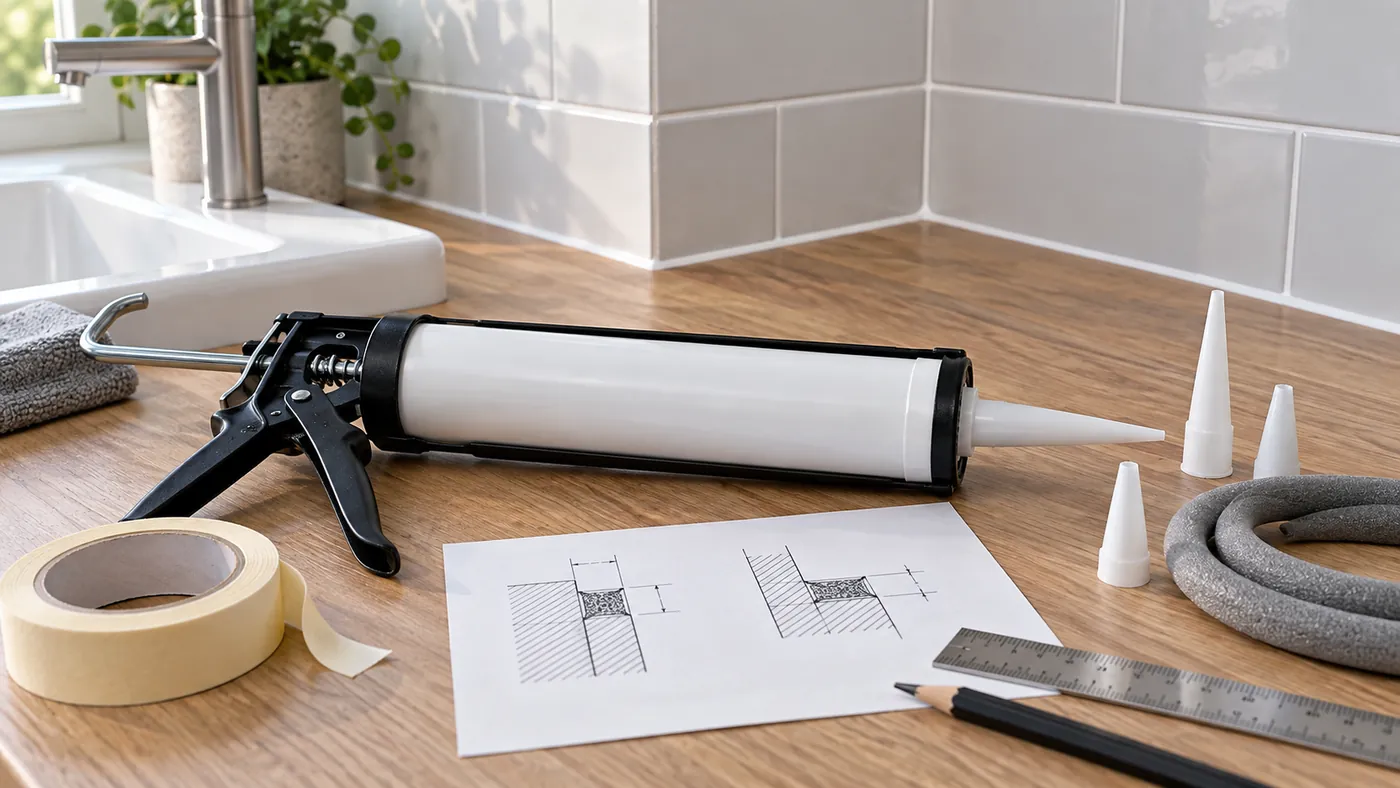
Picture the bead in cross-section. A movement joint filled 10 mm wide and 6 mm deep is roughly rectangular. A neat fillet between a counter and splashback may look triangular, with two visible legs meeting at the corner. Those shapes do not contain the same amount of material even when their visible dimensions appear similar.
The rectangular area is width × depth. The right-triangular area is ½ × leg A × leg B. A round bead is based on the diameter. The calculator includes all three, but use the shape that represents the finished bead after tooling, not the shape of the nozzle opening.
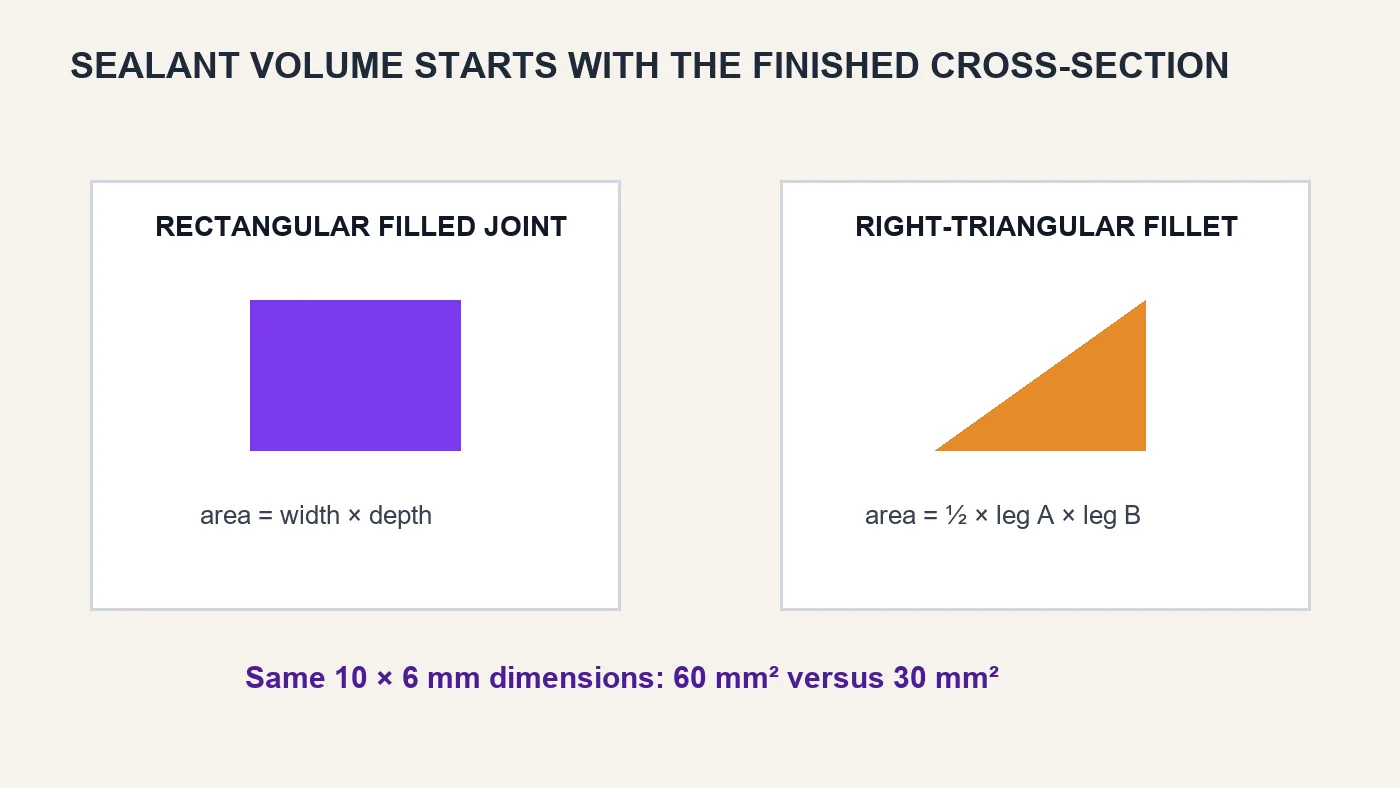
There is a convenient metric relationship behind the calculation: one square millimetre carried along one metre has a volume of one millilitre. A 10 × 6 mm rectangle therefore uses 60 ml per metre. Twelve metres uses 720 ml before waste. For imperial measurements the calculator performs the conversion for you.
Measure the job before opening the calculator
- List separate runs. Treat the bath perimeter, shower tray, worktop and external frame as separate lines. They may use different products or bead sizes.
- Measure the actual route. Follow corners and returns. For repeated windows or panels, measure one only when they truly match, then enter the quantity.
- Decide how many beads. A panel sealed on both edges has two beads even though its physical length was measured once.
- Measure the finished joint. Use width and depth from the specification or product instructions. Do not guess a movement-joint design from the gap you happen to see.
- Check the cartridge. Common packs are labelled by volume. Enter the volume printed on the product you will buy, not a remembered “standard” size.
Deep gaps should not simply be pumped solid. An appropriately sized backing material can control depth and help form the joint specified by the manufacturer. For example, Sika’s application guidance recommends backer rod for deep joints and tells users to follow the product data sheet for joint dimensions. That is a design and application instruction, not merely a way to save sealant.
How to use the sealant calculator, field by field
- Project and units: give the estimate a recognisable name, then choose metric or imperial. Select the currency only if you want a cost total.
- Product: rename the line with the exact material, colour and finish. Keeping sanitary silicone separate from decorator’s caulk prevents an accidental combined order.
- Calculation method: choose joint dimensions when you know the cross-section. Choose manufacturer coverage per cartridge when the data sheet states a linear yield for the same joint size.
- Cartridge size: enter the labelled usable volume. Do not include several cartridges here; pack quantity is handled later.
- Joint shape and dimensions: select rectangular, right-triangular or round. Enter the finished width/depth, legs or diameter requested on screen.
- Joint runs: name each location. Enter a direct measured length, or use the rectangular-perimeter shortcut. Deduct genuine unsealed sections, then set repetitions and beads per run.
- Run overrides: use these when one run has a different bead size. Leaving them blank applies the project default.
- Backer rod: mark only runs that need it. The optional roll length, waste and price fields build a more complete shopping list.
- Waste and stock: add a reasoned reserve for nozzles, tooling and interruptions; enter usable cartridges already owned. The result subtracts stock without hiding the gross requirement.
- Packs and price: if a retailer sells a multipack, enter its cartridge count and pack price. The calculator rounds to purchasable packs.
- Masking tape, labour and extras: add these only if useful to your budget. Tape can be calculated for one or both sides. Labour, extras, markup and tax do not alter physical sealant usage.
The optional bulk entry is useful for many known runs, but the named rows are easier to audit on a first estimate. Use Print / Save PDF once the result is stable so the measurements travel with the shopping list.
Worked example: a 12 m filled joint
Suppose a project has 12 m of rectangular joint, 10 mm wide and 6 mm deep. The product comes in 300 ml cartridges and you choose a 10% reserve.
- Cross-sectional area: 10 × 6 = 60 mm²
- Base volume: 12 × 60 = 720 ml
- With 10% reserve: 720 × 1.10 = 792 ml
- Cartridges: 792 ÷ 300 = 2.64, rounded up to 3 cartridges
Enter metric units, “Calculate from joint dimensions,” a 300 ml cartridge, rectangular joint, 10 mm width, 6 mm depth, and one 12 m run. Set waste to 10%. The calculator should return the same three-cartridge purchase. If one unopened matching cartridge is already in stock, enter 1 in stock and the buy quantity falls to two.
Worked comparison: the same dimensions as a corner fillet
Now treat the visible bead as a right-triangular 10 × 6 mm fillet. Its area is ½ × 10 × 6 = 30 mm². Twelve metres uses 360 ml; with 10% reserve that becomes 396 ml, or two 300 ml cartridges. This comparison explains why choosing the correct cross-section matters. It does not mean you should substitute a triangular fillet where a filled joint is specified.
When manufacturer coverage is the better input
Use the coverage method when the manufacturer publishes a yield for the exact joint geometry. Mapei, for example, gives an indicative yield of 2.8 m from a 280 ml cartridge at 10 × 10 mm for Mapesil Z Plus and notes that consumption varies with joint size. Twelve metres at that stated coverage is 12 ÷ 2.8 = 4.29 cartridges before reserve, so the base purchase rounds to five. Keep the product name, joint size and source with the estimate.
Never borrow one brand’s coverage for a different pack or profile. Check the current product page and data sheet. Useful primary sources include Sika’s sealant application guide and Mapei’s Mapesil Z Plus product information.
Choosing a sensible reserve
Reserve is not a universal percentage. A long, accessible factory-like run may be predictable. A renovation with uneven gaps, many short starts and awkward corners can leave more product in nozzles and partially used cartridges. Base the allowance on the job you measured.
Do not use “waste” to disguise uncertainty about joint depth. Measure again or confirm the specification. Large movement joints, façade work, fire-rated systems, structural glazing and potable-water applications deserve product-specific professional guidance.
Practical checks before buying
- Confirm compatibility with both substrates, primers and existing sealant.
- Match interior/exterior, wet-area, paintability, movement and temperature requirements.
- Buy one colour batch where appearance matters.
- Check shelf life and storage conditions before buying a large case.
- Include suitable cleaner, tooling aids, nozzles, backing material and masking tape.
- Plan removal and preparation time. A quantity result does not mean the surface is ready.
For tiled wet areas, coordinate this estimate with the tile, adhesive and grout guide. For a full bathroom layout and fixtures, use the interactive bathroom planner. If the bead follows new trim, the skirting and architrave calculator can build the stock list first.
A better way to survey a whole room
Walk the room clockwise and give every joint a short name: bath rear, bath end, basin splashback, tray left, tray right, and so on. Put a small pencil mark on a sketch whenever a length has been transferred. This prevents a common estimating error in which an obvious front edge is measured twice while a return behind a fitting is missed. If access will change during the work, note that as well; a joint measured before a panel is fitted may be harder to tool later.
Separate runs whenever geometry changes. Six metres at 5 × 5 mm and six metres at 10 × 8 mm are not a single twelve-metre bead. The larger rectangular section uses more than six times as much material per metre. In the calculator you can either create two named runs and use size overrides, or make two estimates when the runs require different sealants.
How to read the result
The result distinguishes measured length, calculated material volume and the rounded purchase. Read them in that order. Length confirms the survey; volume confirms the geometry; whole cartridges or packs are the shopping quantity. If the total looks surprising, do not immediately change the reserve. Check units, shape, beads per run, repeated quantity and deductions first. A millimetre value entered while imperial mode is selected can distort an otherwise correct-looking form.
Keep gross requirement and stock deduction visible. An opened tube left from another job may have cured in the nozzle or skin over internally, so count it only after checking that it is the correct product, colour and condition. The safest stock entry is unopened, in-date material stored as instructed.
Application planning the quantity cannot solve
A clean number does not guarantee a durable seal. Old material, dust, soap residue, release agents, damp surfaces and unsuitable cleaners can defeat adhesion. Some substrates require a primer; some products must not be used on particular plastics, natural stone or bituminous materials. Masking tape should be removed at the stage specified for the product, and the joint needs its stated cure time before water or movement exposure.
Photograph the product label and batch before starting, and retain the technical sheet with the estimate. If a failure later needs investigation, the record of substrate preparation, weather, joint dimensions and material is far more useful than the cartridge count alone.
Frequently asked questions
How many metres does one silicone cartridge cover?
It depends on cartridge volume and the finished bead cross-section. A 300 ml cartridge theoretically covers 5 m of 10 × 6 mm rectangular joint, but actual purchasing should allow for losses and round up.
Is caulk calculated the same way as silicone?
Volume is calculated the same way. Suitability, shrinkage, tooling, movement capability and application instructions differ, so use the chosen product’s data.
Should I calculate from nozzle diameter?
No. The nozzle controls delivery, while the tooled bead or filled cavity determines final volume. Measure or specify the finished cross-section.
What is a triangular fillet?
It is a corner bead whose cross-section is approximated as a right triangle. The calculator uses half the area of a rectangle with the same two legs.
Do I include backer rod in the sealant depth?
No. Backer rod occupies the space behind the designed sealant joint. Enter only the sealant’s finished depth and calculate rod separately.
Why did the calculator round up?
Cartridges and multipacks are indivisible purchase units. A requirement of 2.01 cartridges still needs three unless suitable stock is already available.
Can I combine different products in one result?
Make separate estimates. Sanitary silicone, exterior sealant and paintable caulk are not interchangeable even if their cartridge sizes match.
How much waste should I add?
Use a job-specific allowance. Consider joint variation, short runs, nozzles, access and your experience. Ten percent is an example, not a rule.
Does the calculator choose the correct joint depth?
No. It calculates the geometry entered. Follow the current product data sheet, specification or qualified advice for joint design.
Can I save the estimate?
Yes. Use Print / Save PDF after checking the run names and inputs, then keep it with the product data sheet and site measurements.