How Many Decking Boards Do I Need? A Practical Board Calculator Guide

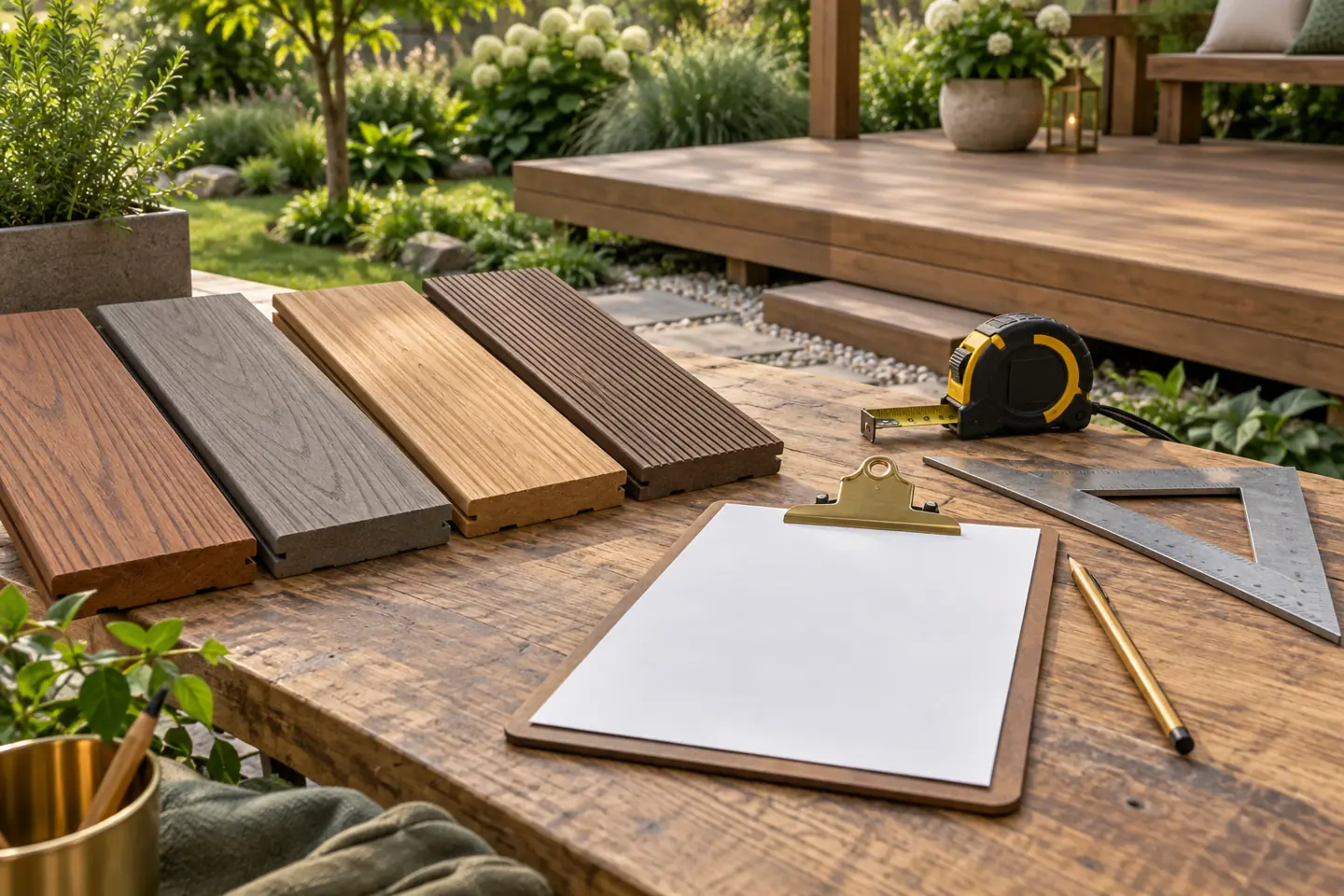
Ordering decking is rarely as simple as dividing the deck area by one board size. Boards are sold by finished width, cover a real gap, come in fixed stock lengths and lose material at cuts around steps, posts and curves. This guide shows how to measure a deck, allow for spacing and waste, and use the Handyman Hub decking calculator to build a supplier-ready board list.
What changes the number of decking boards
The number depends on the deck footprint, board width, the gap between boards, the direction of the boards and the way the stock lengths are used. A 120 mm board with a 5 mm gap covers about 125 mm of deck width on each run. The board’s stated width alone is not its finished coverage.
Boards also vary by material. Softwood, hardwood and composite products have different widths, expansion gaps, fixing rules and available lengths. Follow the installation instructions for the product you actually choose.
Measure the deck in simple sections
Measure a rectangle as length by width. Split an L-shaped or stepped deck into rectangles and keep the measurements on a sketch. Measure stairs, landings, picture-frame borders and separate seating areas as their own sections because they often use boards in a different direction.
For a curved edge, calculate the main rectangle first and treat the curve as a cutting area. Do not measure only the longest side; that can overstate the boards needed for one section and hide a shortage in another.
Use effective cover width
Add the board width and the intended gap to find the effective cover width. If a board is 120 mm wide and the gap is 5 mm, the planning cover is 0.125 m. Check whether the supplier quotes width as actual or nominal and whether the recommended gap changes with moisture and temperature.
Worked example: a 4 m by 3.6 m deck
A 4 m by 3.6 m rectangle has an area of 14.4 m². With a 120 mm board and a 5 mm gap, the effective cover is 0.125 m. Across the 4 m length, you need 4 ÷ 0.125 = 32 board runs. If boards are laid across the 3.6 m direction, each run needs a 3.6 m board or a planned combination of stock lengths. The purchase list must therefore consider both the number of runs and the available board lengths.
For a straightforward layout, add a clearly stated allowance for trimming and selection. A 10% allowance would take 14.4 m² to 15.84 m² of planning coverage, but the final board count should still be rounded to whole stock lengths rather than treated as a loose area figure.
Use the decking calculator step by step
- Open the decking calculator.
- Select the units used on your drawing and by your supplier.
- Enter each deck section’s length and width.
- Enter the actual board width and the recommended gap.
- Choose the board direction and stock length where the calculator offers it.
- Review the coverage and waste allowance.
- Save the result with the material, board profile and supplier assumptions.
Use the aggregate calculator separately if you also need a sub-base. Boards, joists, concrete pads and aggregate are separate lines on a sensible order list.
Direction, joins and board lengths
Laying boards along the long dimension can reduce joins, but it may create more short cuts at the edges. Laying across the short dimension can change the number of runs and the stock lengths required. Draw the joist direction and board direction together before ordering.
Stagger butt joints between rows and make sure every joint has the support and fixing detail required by the product instructions. A board-area calculation cannot check joist spacing, ventilation or end-grain treatment.
Borders, steps and picture frames
A picture-frame border often uses additional boards and creates short pieces that cannot be counted as ordinary runs. Stairs need enough boards for treads, risers, nosings and side trims. Measure these separately and add their fixings and support framing to the materials list.
Waste and supplier checks
Waste is influenced by the deck shape, board length, grain or colour matching and your cutting plan. Use a higher allowance for curves, diagonal patterns and picture frames than for a plain rectangle. Keep the allowance visible so you can reduce it after a cutting plan has been drawn.
Ask the supplier about minimum order lengths, batch colour, hidden clips, screws, fascia boards and delivery restrictions. Composite boards can have different expansion gaps and may not be interchangeable with timber boards.
Common decking quantity mistakes
Dividing area by board width only
Include the installation gap in the effective cover width.
Ignoring board direction
The same area can need different stock lengths depending on which way the boards run.
Counting the main field but not the edges
Add borders, steps, risers and trims separately.
Using waste to hide poor measurements
Measure sections accurately, then add a reasoned allowance.
Forgetting the support system
Boards are only one part of the order. Check joists, noggins, posts, pads, fixings and drainage.
Decking order checklist
- Sketch each deck section and board direction.
- Confirm board width, gap and stock lengths.
- Measure borders, stairs, landings and trims separately.
- Calculate board coverage before adding waste.
- Check joist spacing and fixing requirements.
- Confirm batch colour, clips, screws and delivery access.
- Save the final board list with the date and supplier assumptions.
The Timber Decking and Cladding Association is a useful independent reference for timber decking guidance. Product installation instructions remain the controlling source for your chosen system.
Frequently asked questions
How many boards do I need for a 10 m² deck?
Use the effective cover width, board direction and stock lengths rather than dividing 10 m² by nominal board area. Add a sensible cutting allowance and round up.
What gap should I leave between decking boards?
Use the gap specified for the product. Timber moisture and composite expansion can change the required spacing.
Should decking waste be 10%?
Ten per cent can suit a simple rectangular layout, but curves, diagonal patterns, borders and stairs may need more. Draw the cuts and explain the allowance.
Is a longer board always better?
Longer boards reduce joins but may create more waste and handling difficulty. Compare stock lengths with the deck layout.
Does the calculator include joists?
Use the calculator’s output for board quantities, then calculate the support frame and fixings separately.
Can I calculate composite decking the same way?
The area method is similar, but follow the composite manufacturer’s cover width, expansion gaps, clips and support spacing.
Final board-count check
Before buying, compare the saved calculator result with your sketch, board direction, stock lengths, borders, stairs, waste allowance and supplier’s product instructions. That review turns a rough area estimate into a realistic decking order.