
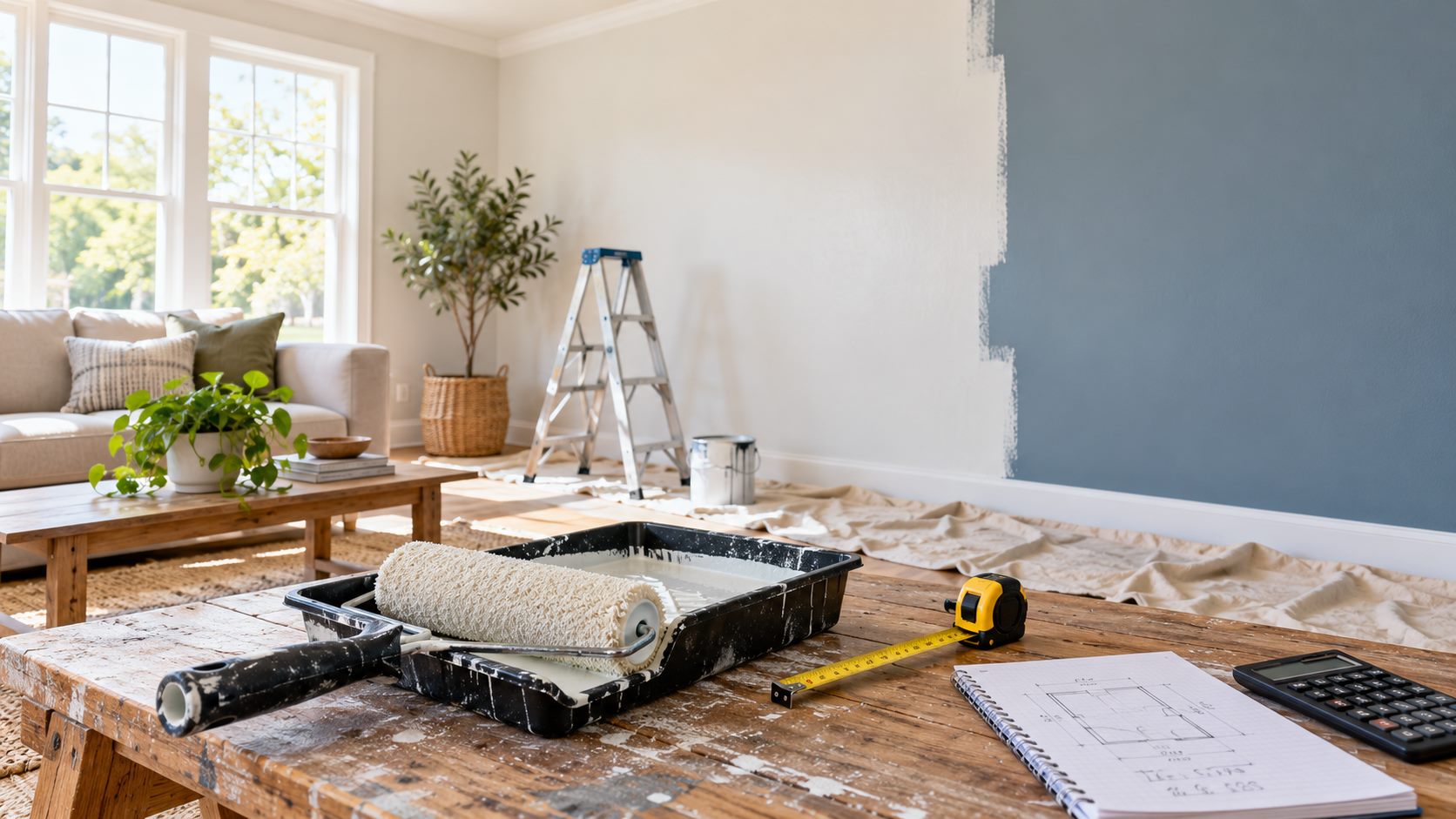
Paint estimates are easiest when you separate surface area from the product you will buy. Measure the walls and ceiling, subtract large openings, then allow for coats and the coverage printed on the tin. Our painting and decorating calculator does the arithmetic, but the result remains an estimate because texture, porosity, colour change and application method affect coverage.
Measure the surfaces you will paint
For a rectangular room, multiply the perimeter by wall height. A 12 ft by 10 ft room with 8 ft walls has 44 ft of perimeter and 352 sq ft of gross wall area. Add the ceiling separately: 12 × 10 gives 120 sq ft. Subtract genuine openings: a 3 ft by 7 ft door removes 21 sq ft and two 4 ft by 4 ft windows remove 32 sq ft, leaving 299 sq ft of net wall area.
Allow for coats
Coat count is a planning choice. Similar colour over a sound sealed surface may need one finish coat; a strong colour change, fresh plaster or repaired patches commonly needs primer and two finish coats. In this room, two finish coats on 299 sq ft of walls require 598 sq ft of coverage, and two coats on the 120 sq ft ceiling require another 240 sq ft: 838 sq ft before waste.
Coverage is not a guarantee
Labels quote theoretical coverage at a particular film thickness and on a smooth surface. Textured walls, thirsty plaster, roller nap, cutting-in and paint left in the tray reduce practical coverage. Enter the manufacturer’s stated coverage for the product you intend to buy. At 350 sq ft per gallon, 838 sq ft needs about 2.4 gallons for the finish coats, so round up to a practical container size.
Use the calculator transparently
- Choose feet and inches or metric before entering measurements.
- Enter length, width and wall height.
- Enter doors and windows separately, or subtract their measured area.
- Set wall and ceiling coats independently.
- Use the coverage from the product technical sheet.
- Choose a stated waste allowance and record why it was used.
Save product name, sheen, colour and batch information beside the result. Use the hourly and day-rate calculator separately for labour so litres and labour hours remain clear in a quote.
Preparation changes the quantity
Filling, sanding and sealing alter the surface. Porous repairs can draw in the first coat while glossy patches may reject it. Dust can load a roller and reduce coverage. Split estimates into plaster, previously painted wall, woodwork and metal when substrates or products differ. A washable satin for trim is not interchangeable with matt emulsion for a ceiling.
Check whether new plaster needs a mist coat or the primer specified by the manufacturer. Treat stains, nicotine, water marks and glossy existing paint before estimating the finish coat. Benjamin Moore’s coverage guidance explains why texture and application matter. Follow the US EPA indoor-air guidance and the coating manufacturer’s ventilation instructions.
Worked example: a colour change
Suppose the room has a dark blue feature wall changing to pale colour, plus four repaired patches. Keep the feature wall as its own line: it is 96 sq ft, so two finish coats add 192 sq ft. Spot-prime repairs where the product system allows it, then use the recommended first coat for the colour change. Writing each wall separately prevents double counting.
Openings, trim and room shapes
Subtracting large patio doors and windows improves a whole-room estimate. Very small openings may still be painted around their reveals, and a professional may carry a practical minimum to avoid running short during cutting-in. Estimate doors, skirting and trim separately because they use different products and sheens. For an L-shaped room, split the plan into rectangles and make sure shared walls are not counted twice.
Common mistakes
- Multiplying length by width and calling it wall area.
- Entering one-coat coverage while planning two coats.
- Mixing imperial dimensions and metric coverage.
- Subtracting openings but forgetting reveals or returns.
- Rounding down instead of buying the next sensible container size.
Frequently asked questions
Should I calculate paint by floor area?
No. Wall paint depends on perimeter and height; ceilings use plan area.
Do two coats mean twice as much paint?
Approximately, but the first coat may soak in or seal differently. Enter the coat count and product coverage.
What if the wall is textured?
Expect lower coverage than on a smooth wall. Use product guidance or increase the allowance after testing a sample.
Can I use the calculator for exterior paint?
Use the geometry, but enter the exterior product’s own coverage and follow its substrate and weather guidance.
How much should I keep for touch-ups?
Keep a small labelled amount from the same batch where practical, with colour code, sheen and date recorded.
Should I round up or down?
Round up to a practical container size after applying coat and waste assumptions.
Check your numbers: use the free paint quantity and decorating calculator while you confirm preparation, coverage and container sizes.