
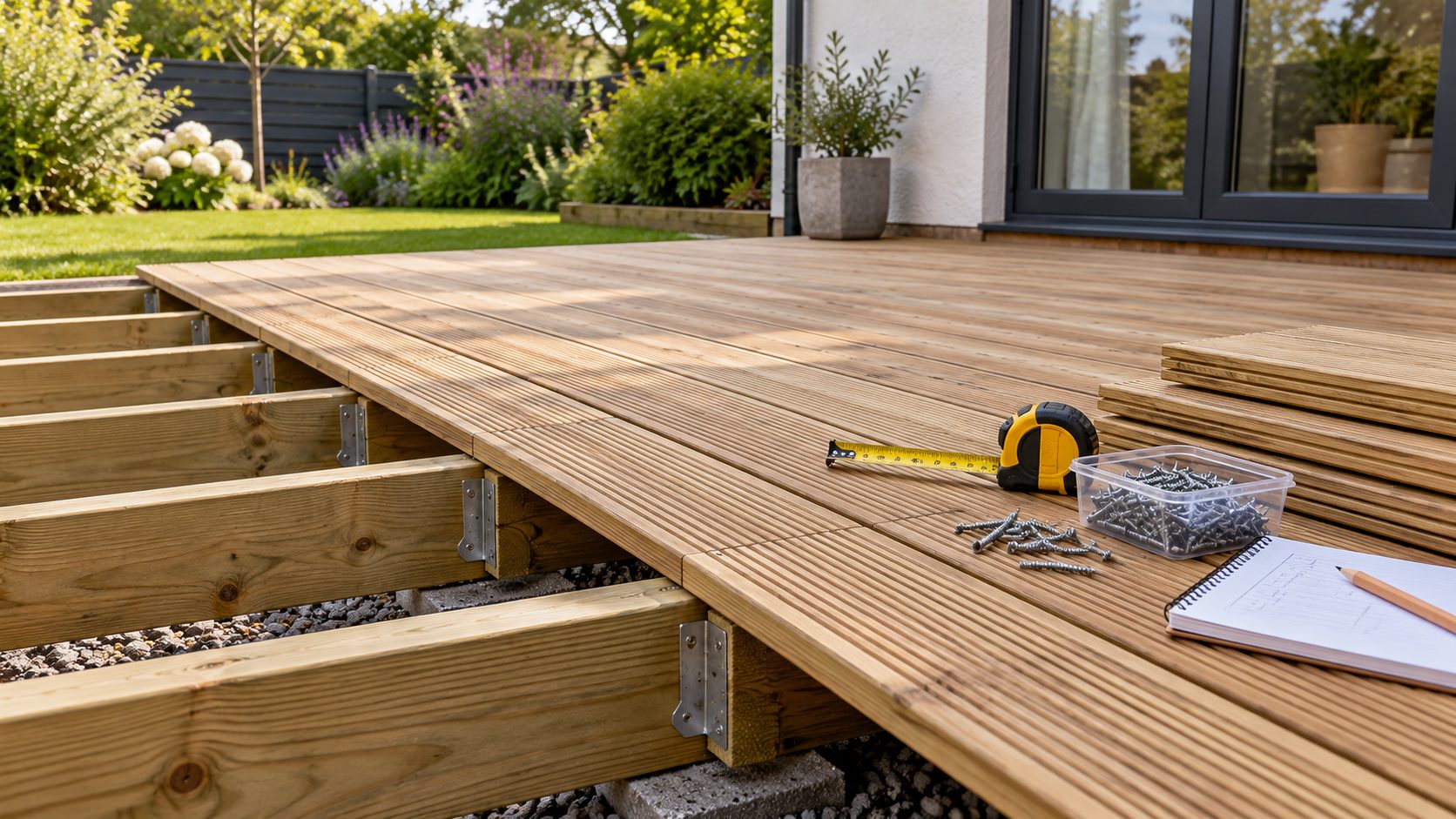
The cost of a deck is driven by its measured area, height, shape, substructure, material choice and access. A board-only price can look attractive while leaving out joists, supports, fixings, stairs, edging, delivery and labour. Start with the decking calculator for a transparent quantity estimate, then build a quote from the same assumptions.
What a realistic deck budget contains
Split the project into ground preparation, supports, joists and framing, deck boards, fascia and edging, steps or balustrade, fixings, delivery, waste removal and labour. A low platform on a simple rectangle is a different job from a high deck with stairs and guarding even when the surface area is identical.
For a worked example, imagine a 12 ft by 16 ft rectangular deck. Its gross area is 192 sq ft. Add a 10% board allowance for cuts and selection: 211 sq ft of decking surface to price. That allowance belongs to the surface boards; do not automatically add ten percent to every structural component.
Board quantity is only the first calculation
Board width, length, laying direction and gaps determine how much stock you purchase. If boards run across the 12 ft direction, each course spans roughly 12 ft and the number of courses is based on the 16 ft dimension. The other direction changes joints and stock use. Use the calculator to compare layouts, then confirm the result on a measured drawing.
Enter finished length and width, board width, gap and waste allowance. Check whether output is boards, linear feet or square feet before comparing it with a supplier’s pack price. Mixed lengths and pack rounding can make the cheapest arithmetic option awkward to order.
Framing, supports and height change the price
Joist spacing must match the board product and project requirements. The calculator can estimate a quantity from the spacing entered; it does not certify a span, beam size, post size, footing or connection. Keep those decisions with the site-specific design and product instructions.
Measure height from finished ground or landing to finished deck surface. Higher work often needs extra posts, bracing, stairs, handrails and guarding. Include them as separate lines. A ledger fixed to a house also needs a site-specific check for structure, waterproofing and access.
A simple budget example
Suppose the example deck uses 211 sq ft of boards at $5.25 per sq ft: about $1,108. Add framing timber at $850, supports and hardware at $420, fascia and steps at $380, delivery at $180, and a measured labour allowance of $1,450. The planning total is $4,388 before tax and unknown ground conditions.
This is a method example, not a market quote. Replace each allowance with a supplier price or measured labour calculation. Label unknown packages “unpriced” rather than treating them as zero. Compare the labour assumption with the hourly and day-rate calculator and keep markup separate from direct cost.
Material choices
Pressure-treated timber often has a lower initial cost and needs maintenance. Composite boards can cost more up front but may reduce finishing work. Hardwood, grooved boards, picture-frame borders and hidden clips change product price and installation time. Ask for exact board width, effective cover, recommended gaps, joist spacing and fixing system before swapping products in the calculator.
Manufacturer instructions beat generic internet rules. The Trex installation resources set out product-specific spacing and fixing details. Treat them as controlling instructions for that product, not universal engineering advice.
Ground conditions, access and demolition
- Note whether the area is lawn, paving, gravel or a sloping bank.
- Allow for excavation, spoil, drainage, weed control and supports.
- Measure the delivery route and note gates, steps and narrow passages.
- Price old deck removal, disposal and protection of adjoining planting or walls.
- Record finish, border, step position and railing length in the quote scope.
Keep uncertain ground work visible as an allowance with a trigger such as additional excavation if soft ground is found. That is more useful than hiding a contingency inside the board rate.
Compare two layouts before choosing a price
Draw board runs, mark the border and write stock lengths beside each run. A slightly higher square-foot quantity can still be the lower purchase cost if it avoids many short offcuts. Picture-frame borders deserve their own line because they change the usable field and introduce mitred or butt-jointed pieces.
Labour is a sequence
Break labour into setting out, preparation, supports, framing, boarding, stairs and finishing. The same 192 sq ft can take very different hours depending on access, cutting, border detail and levels. Show direct materials, direct labour, delivery and markup separately so a product change does not accidentally change the labour allowance.
Ordering checklist
- Save the drawing with a revision date and board direction.
- Confirm effective board cover, gap, stock lengths and pack sizes.
- Check calculator output against course count and border lengths.
- List joists, beams, posts, brackets, fixings and stairs separately.
- Re-run the estimate after changes to height, steps, railing or board profile.
Frequently asked questions
How much does a deck cost per square foot?
A square-foot figure is a rough starting point because height, stairs, access and substructure vary. Use it to sanity-check a detailed take-off.
Does the calculator design the structure?
No. It estimates quantities from dimensions and spacing. Confirm spans, posts, footings, ledgers, guards and connections for the actual site and product.
How much waste should I allow?
Use an allowance based on board length, pattern, borders and cutting. Ten percent is a planning example, not a fixed rule.
Should stairs be included in the deck area?
Price stairs separately because treads, risers, stringers, supports and guards are not represented by a simple rectangle.
Does composite always cost more?
Boards often cost more, but the total depends on frame, clips, waste, finishing and maintenance. Compare complete packages.
How should I price a raised deck?
Price extra structure, access, stairs, guarding, bracing and inspection needs as separate packages. Height is a scope change.
What if supplier quantity differs?
Check units, effective cover, pack rounding, board direction and waste. Ask the supplier to explain the difference and keep both calculations with the drawing.
Build a clearer estimate: enter dimensions in the free decking boards, joists and cost calculator, then use the result as your supplier quote schedule.