
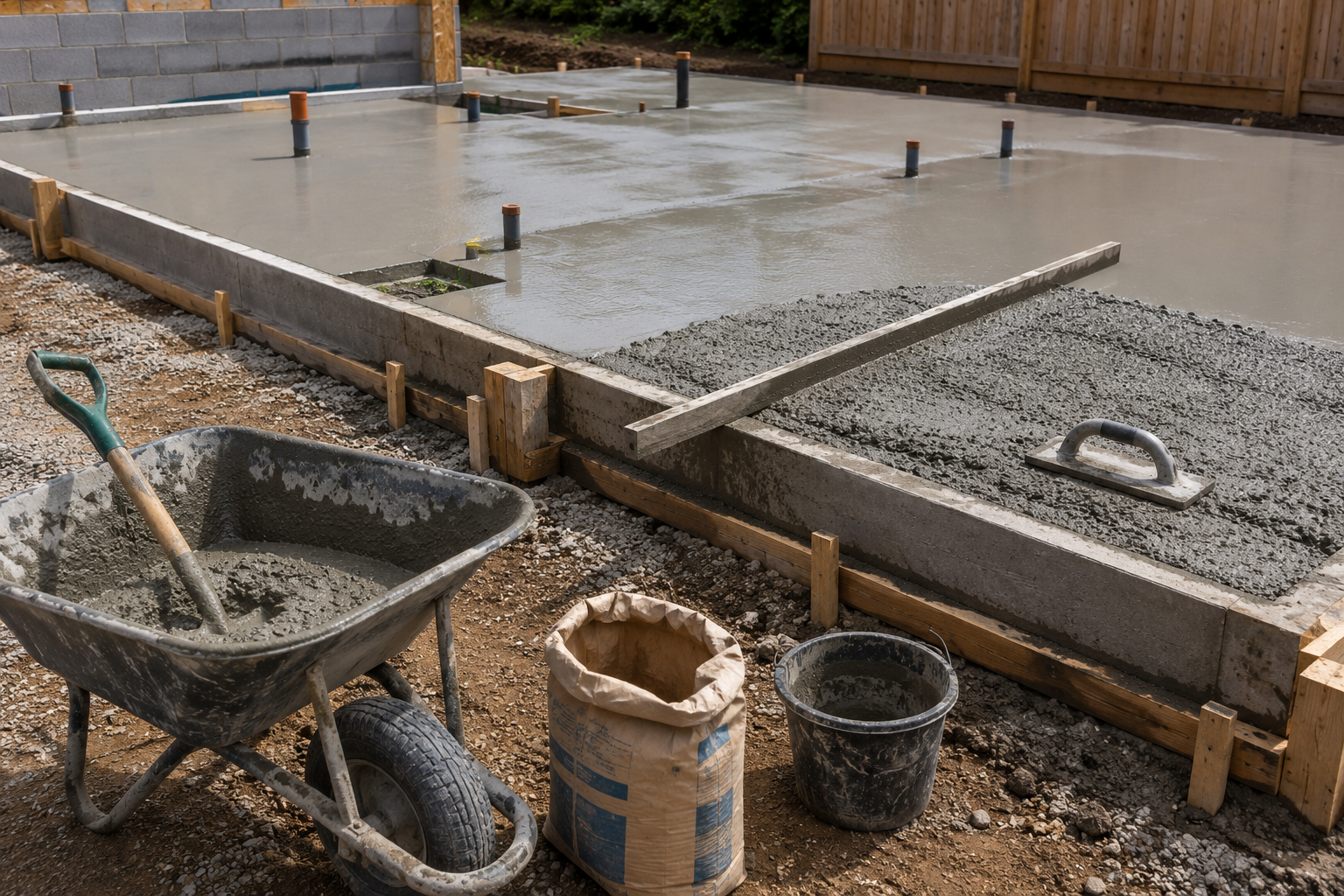
Buying concrete by the bag feels straightforward until the first calculation comes back in cubic feet, cubic yards or cubic metres. The reliable way to plan is to calculate the volume first, then match that volume to the yield printed on the exact bag you intend to buy. This guide explains the process, shows a worked example and points you to the Handyman Hub concrete calculator for a faster check.
Why bag count depends on yield, not weight
A 60 lb bag, 25 kg bag or 20 kg bag does not represent a universal amount of finished concrete. The mix design, aggregate size, moisture and manufacturer all affect coverage. Read the yield table on the packaging or technical data sheet. If the label says one bag yields 0.45 cubic feet, that figure is the number you divide into your required volume.
Never combine a bag weight from one product with the yield from another. Keep a note of the brand, product name and pack size when you compare supplier prices.
Step 1: calculate the required volume
For a rectangular slab, footing or pad:
Length × width × depth = volume
Use feet for all three measurements if you want cubic feet. Use metres for all three if you want cubic metres. For inches, convert the depth to feet before multiplying, or convert all dimensions to inches and divide the cubic-inch result by 1,728 to obtain cubic feet.
Worked example: a small garden pad
Imagine a 6 ft × 4 ft pad that is 4 in thick. Convert 4 in to feet: 4 ÷ 12 = 0.333 ft. The core volume is 6 × 4 × 0.333, or about 8 cubic feet.
Suppose the chosen bag states a yield of 0.60 cubic feet. Divide 8 by 0.60: the unrounded result is 13.33 bags. You cannot buy one-third of a bag, so the minimum order is 14 bags before an allowance. If the ground is uneven or the formwork may vary, a spare bag or a separately stated contingency is sensible.
Use the concrete calculator step by step
- Open the concrete calculator.
- Select feet, inches, metres or the unit system that matches your measurements.
- Enter the finished length, width and thickness of the pour.
- Read the calculated volume before adding any allowance.
- Check the bag label for finished yield, not just weight.
- Divide volume by yield and round up to whole bags.
- Record the product and allowance so a supplier can review the order.
If your project is a shed base, compare the estimate with our guide to concrete for a shed base. For fence footings, use the separate example for concrete for fence posts, because cylindrical holes need a different calculation.
Allowances: what should you include?
An allowance covers measured uncertainty, small spills and minor irregularities. It should not conceal a guess about the slab size. Keep the core volume and allowance as separate lines in your notes.
- Neat, level formwork: a modest allowance may be enough.
- Uneven excavation: remeasure low areas after the sub-base is compacted.
- Hand mixing: allow for small handling losses and bags that are damaged by weather.
- Thickened edges or steps: calculate these separately rather than applying a large blanket percentage.
- Supplier minimums: ready-mix orders may be rounded to a truck minimum instead of bag count.
Bagged concrete versus ready-mix
Bagged concrete is convenient for small pads, post holes and repairs where access is difficult. It becomes labour-intensive when the volume grows: every bag must be carried, measured, mixed and placed within the working time.
Ready-mix can be more efficient for larger pours, but ask about minimum loads, part-load fees, access, discharge time and the mix specification. Give the supplier your dimensions, core volume, allowance and site access. Do not assume a quote described as “one load” equals a fixed number of cubic yards or metres.
Common mistakes that cause shortages
Using bag weight as the calculation
Weight tells you how much dry product is in the bag. Yield tells you how much finished concrete it produces. Use yield.
Mixing units
Converting only one dimension can create a large error. Write the unit beside every measurement before multiplying.
Forgetting openings or separate pours
A pad with a step, thickened edge or isolated footing should be split into simple shapes and added together.
Rounding down
Always round bag counts up. If the calculated result is close to a whole bag, the next bag is cheaper than stopping mid-pour.
Storing bags in damp conditions
Moisture can start hydration inside the bag and leave you with lumpy or unusable material. Keep bags dry and raised from the ground.
Practical mixing and placing checklist
- Prepare and compact the sub-base before opening bags.
- Set square, braced formwork and confirm the finished depth.
- Have water, mixer, tools and help ready before mixing.
- Follow the exact water and mixing time on the product label.
- Place continuously where the design calls for one pour.
- Compact and level the concrete without adding unplanned water.
- Protect the pour and follow the stated cure time before loading it.
For broader technical background, the American Concrete Institute publishes concrete guidance. Product manufacturers such as QUIKRETE also publish bag yields and mixing instructions; always use the data for the product actually purchased.
Frequently asked questions
How many 20 kg bags of concrete do I need?
There is no universal answer because 20 kg products have different yields. Calculate the required volume, then divide by the yield printed on your chosen bag.
How many 60 lb bags make a cubic yard?
It depends on the product yield. One cubic yard is 27 cubic feet, so divide 27 by the bag’s stated cubic-foot yield and round up. Check the label before ordering.
Should I subtract the volume of reinforcement or a post?
For a small estimate, many people leave that displacement within the allowance. For a large or tightly reinforced pour, ask the designer or supplier whether it should be deducted explicitly.
How much extra concrete should I buy?
Use a modest allowance based on measurement confidence, ground conditions and handling. Keep it visible as a separate line rather than hiding it in the core volume.
Can I use this method for round post holes?
Use the cylinder formula instead: π × radius × radius × depth, multiplied by the number of holes. Our fence-post guide shows the worked method.
Does the calculator approve my slab thickness?
No. It estimates volume from your chosen dimensions. Soil, drainage, loads, reinforcement, frost and local requirements may need professional or authority advice.
Final ordering checklist
- Confirm the finished dimensions and separate shapes.
- Convert every dimension to one unit.
- Calculate core volume with the concrete calculator.
- Check the exact bag yield or ready-mix unit.
- Round up and list the allowance separately.
- Confirm storage, access, mixing and cure arrangements.
Once the dimensions are confirmed, save the calculator result with the product name and date. That makes supplier quotes easier to compare and gives you a clear record if the design changes.