
Repointing mortar fills joints, not the entire thickness of a wall. To estimate it, measure the joints being treated and the specified refill depth, then convert that finished mortar volume into the chosen product’s yield. A wall-area figure without joint dimensions cannot give a dependable order.
The repointing mortar calculator offers regular wall-face and directly measured joint-length methods. Both are quantity models. They do not decide which mortar is compatible with the building or how deeply old joints can safely be prepared.
Set the repair scope before measuring
Mark which sections need treatment. Photograph and label the areas so a full-wall estimate isn’t mistaken for selective repairs, or vice versa. Bulging masonry, active movement, damaged units and persistent moisture may require a different investigation before a repointing quantity is useful.
For historic masonry, the National Park Service’s Preservation Brief 2 discusses investigation and mortar compatibility. Use a qualified assessment where necessary. A harder mortar is not automatically a better repair, and the calculator’s depth field is not a recommendation to remove material to that depth.
Once the repair method is specified, divide the work into areas with similar joint widths and depths. A shallow weathered panel and a section with deeper voids should not silently share one average if their material needs are meaningfully different.
Choose the measurement method
For regular brickwork, the face-area method uses the unit face dimensions, bed-joint width and vertical-joint width to estimate how much of the face consists of joints. Enter deductions for openings and the percentage of the section being treated.
For isolated repairs or a layout that doesn’t suit a repeating brick module, directly measured joint lengths can be clearer. Measure the horizontal and vertical sections actually included in the work. Use consistent start and end points so intersections are not counted twice.
Irregular rubble masonry often needs local measurements, trial quantities and specialist judgment. A repeating rectangular brick model should not be presented as an accurate description of every stone wall. The tool gives you a choice of method precisely because one geometric shortcut cannot fit all repairs.
A directly measured joint example
Suppose the measured scope contains 300 linear feet of joints. For this quantity example only, assume an average width of ⅜ inch and an already specified fill depth of ¾ inch. Convert each cross-section dimension to feet before multiplying.
The baseline is 300 × (0.375 ÷ 12) × (0.75 ÷ 12) = 0.5859375 cubic feet. With an illustrative 15% allowance for the assessed job, the target becomes approximately 0.673828 cubic feet.
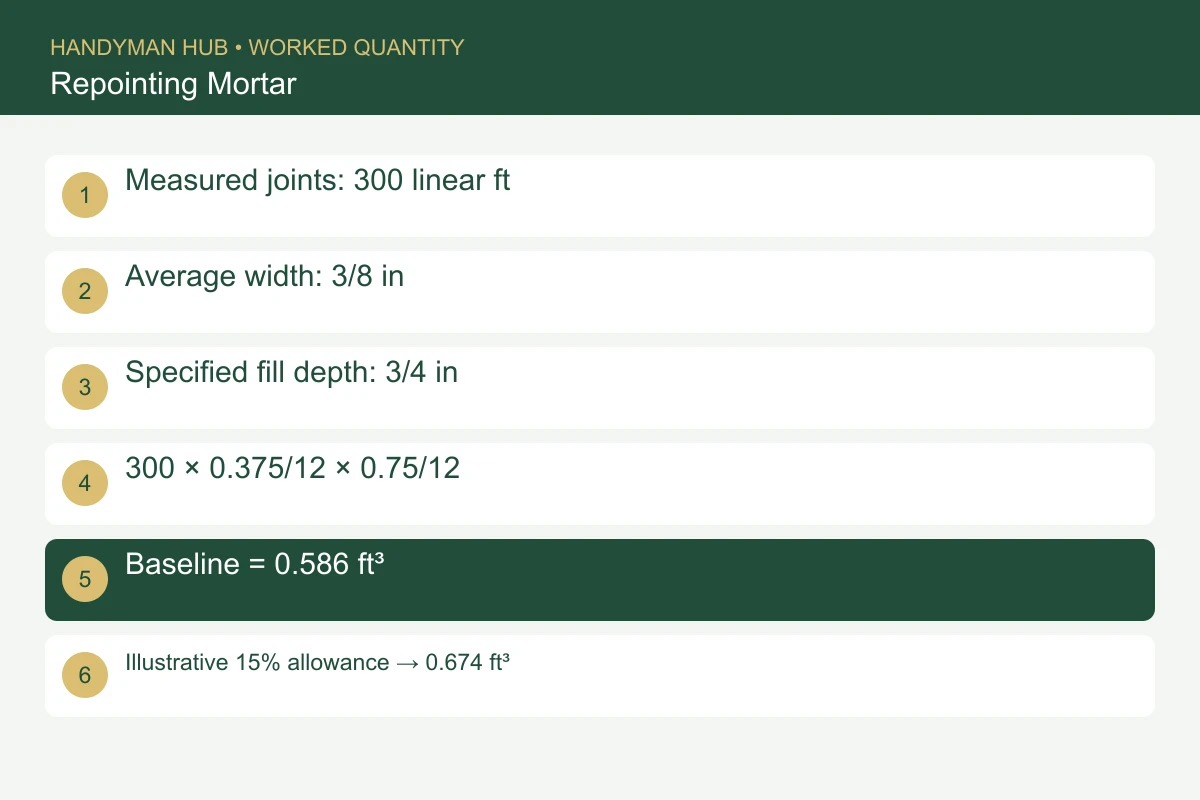
In the live calculator, choose Imperial and directly measured joint lengths. Enter width 0.375 inch, depth 0.75 inch and a 300-foot joint length. Keep treatment at 100% and select finished mortar volume only. Add 15% waste to reproduce the adjusted target. These dimensions and allowance demonstrate the calculation, not a repair specification.
If the specified depth were 1 inch instead, the same 300 feet and width would require 0.78125 cubic feet before allowance. That is one-third more than the ¾-inch-depth example. Measuring depth carefully can matter more than selecting a slightly different waste percentage.
Use finished yield for bags or tubs
Ask how much finished mortar one bag or tub supplies for the intended preparation. A bag’s dry weight isn’t a volume. Likewise, square-foot coverage is only useful when its stated joint width, depth and masonry layout are appropriate.
For a purely hypothetical finished yield of 0.25 cubic feet per container, the adjusted example needs 0.673828 ÷ 0.25 = 2.695 containers, rounded up to three. The supplied 0.75 cubic feet exceeds the adjusted target because of whole-container rounding. Don’t add that surplus as another waste percentage.
Lancaster Lime Works’ Bowman Red mortar page ties its approximate repointing coverage to stated joint dimensions. That is the kind of qualification to look for in product literature. It does not mean that product, color or coverage applies to every wall.
Use the supplier’s current instructions for mixing, application and curing. This guide does not replace those instructions or specify a mortar recipe. When matching existing work, agree on the sample and finish before turning an estimate into a full purchase.
Record partial treatment honestly
A percentage is useful when the assessed treated portion of a regular wall is known. It is less useful when “about half” is just a guess from ground level. Mark treated areas on the elevation or measure the repair lengths more directly.
If one section has deeper joints, use a separate row or depth override instead of increasing the waste percentage to hide it. The quantity then remains connected to the real reason for the extra mortar. Keep deductions for openings separate from the treatment percentage as well.
Allow for material that cannot be reused after preparation or handling according to the product and work sequence. Small batches and interrupted access can affect consumption, but the appropriate allowance should come from the actual repair method rather than a universal rule.
Mortar volume isn’t the whole repair price
Preparation, access, protection, cleaning, disposal and pointing labor may be separate costs. Record which tasks a contractor’s rate includes. A small mortar order can still belong to a labor-intensive job with difficult access or careful hand preparation.
Use the job-pricing guide if you are building a quote, and distinguish this repair takeoff from new brick and block quantities. The two articles use different volume models because the work is different.
Save the repointing estimate with the marked repair scope, measured joint dimensions, product yield and sample decision. That record gives the person doing the work a chance to challenge the assumptions before material is ordered.
Featured image: original concept illustration, not a completed Handyman Hub customer project.