
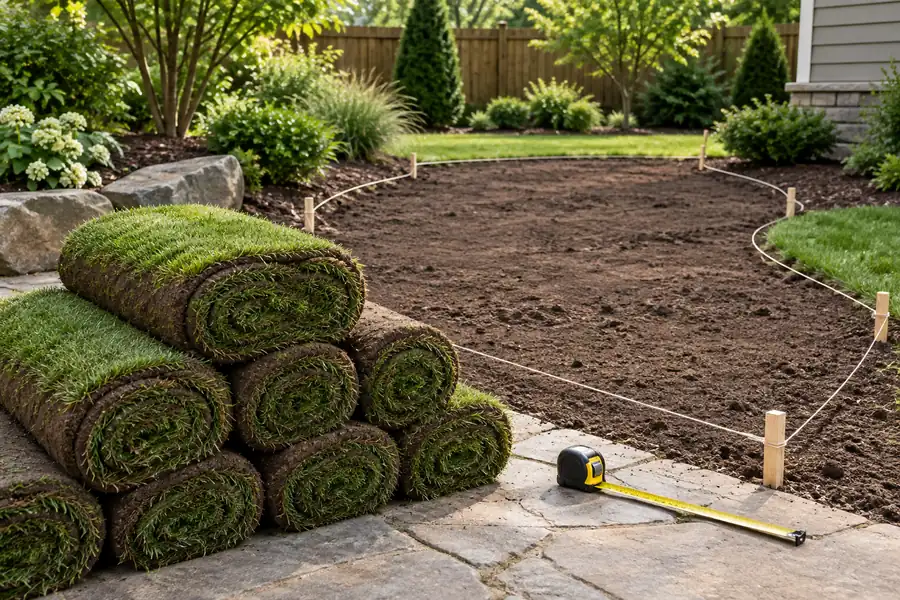
Measure the area that will actually receive sod, add a deliberate cutting allowance, then round to the supplier’s roll or pallet size. Those are three different steps. Buying from the outside dimensions of an irregular yard without removing paths and planting beds can make the allowance much larger than intended.
Our turf calculator covers natural sod. “Turf” is the label used on the tool; this guide uses the common US term sod. For manufactured turf rolls with pile direction and long seams, use the separate artificial-grass ordering guide.
Turn the lawn outline into measurable shapes
Make a simple plan of the prepared lawn area. Split it into rectangles and triangles where possible, and write a dimension on each part. Rectangle area is length times width. Triangle area is base times perpendicular height divided by two; the sloping edge is not the height.
For a curve, take several widths at regular intervals and break it into smaller areas, or use a reliable measured plan. A tighter approximation around the curve is usually more useful than increasing the waste percentage to cover an uncertain measurement. Identify areas that remain estimates and remeasure them before delivery.
Deduct patios, beds and permanent features that won’t receive sod. Be careful at the joins between your shapes: overlapping rectangles count the same lawn twice. A photograph is useful for discussing the job, but it isn’t a scale measurement unless a trustworthy scale has been established.
Worked example: a rectangle and a triangular extension
Suppose the main rectangle is 20 by 18 feet, giving 360 square feet. A triangular extension has a 10-foot base and a 12-foot perpendicular height, giving another 60 square feet. With no overlap between them, the net lawn area is 420 square feet.
For this example, choose a 5% cutting allowance. That increases the target to 441 square feet. If the selected sod pieces cover 10 square feet each, divide 441 by 10 and round 44.1 up to 45 pieces. Their stated coverage totals 450 square feet.
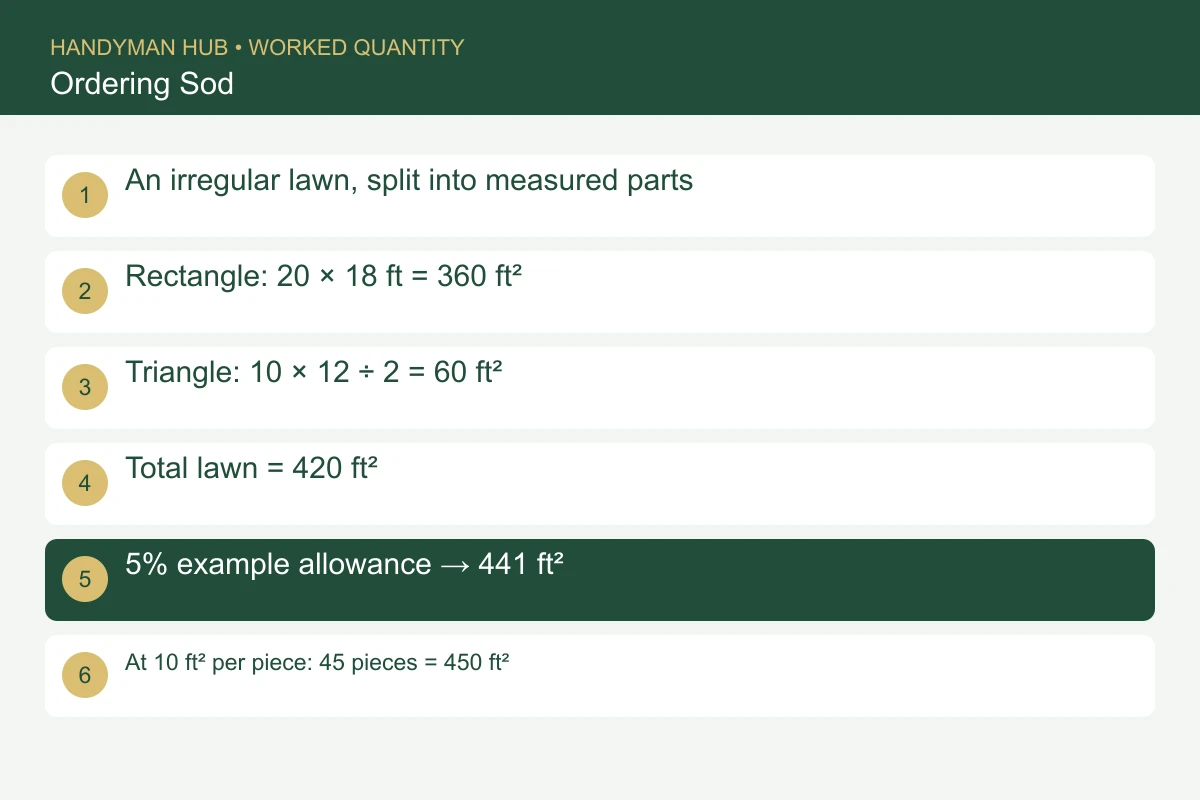
In the live calculator, choose Imperial and enter 420 as a directly measured square-foot area. Set the stated coverage per roll to 10 square feet, waste to 5%, and pack size to one for individually purchased pieces. The result is 45 pieces. The example coverage and allowance are hypothetical; replace them with your farm’s actual product information and the cutting plan.
The 9 square feet between the 441-square-foot target and the 450-square-foot purchase is rounding surplus. It isn’t an additional percentage that you need to enter. Keeping net area, adjusted target and purchased coverage visible helps prevent the same allowance being added twice.
Ask what one pallet contains
Suppliers may sell pieces, rolls, partial pallets or whole pallets, and pallet coverage varies. Don’t assume a familiar pallet size applies to every grass type or farm. Get the stated usable coverage and the actual sale increment in writing.
If the example supplier only sold packs of ten 10-square-foot pieces, the 45-piece requirement would round to five packs, or 500 square feet. That is a purchasing constraint rather than a change to the lawn measurement. It may be worth asking whether smaller quantities are available, but only count an option the supplier actually offers.
For several lawns, decide whether pieces can be shared during one installation. Pooling areas before rounding can reduce the order. Separate delivery dates or isolated jobs may need separate rounding. The calculator offers both approaches; choose the one that matches how you will use the sod.
A cutting allowance is not permission to stretch sod
Think about narrow strips, curved edges, tree surrounds and the starting line. A broad rectangle often offers better use of full pieces than many small islands. Mark where larger remnants might fit before assuming that all offcuts are reusable.
Do not plan to make a short order fit by leaving gaps or treating every thin trimming as a useful piece. Ask your supplier about handling and laying the particular sod. Super-Sod’s installation guide discusses site preparation, edge cuts and delivery timing. Use the relevant local supplier’s instructions for the grass and conditions you actually have.
The percentage should cover expected cuts and ordinary handling losses, not an unresolved measurement. If you’re unsure whether a curved bed is 50 or 100 square feet, measure it again. A vague allowance cannot make that uncertainty disappear.
Finish preparation before arranging delivery
Confirm the grass choice, site preparation and watering arrangements before placing the final delivery date. Super-Sod advises preparing the site first and installing promptly on delivery day. Don’t treat fresh sod as a material that can wait while you finish excavation or find a way to move it.
Soil quantities belong in their own calculation. The topsoil guide uses the added soil depth, while sod ordering uses surface area. A 5% sod cutting allowance is not automatically a 5% soil allowance. Likewise, adding soil depth changes volume without necessarily changing the lawn’s square footage.
For any ground disturbance during preparation, follow the relevant 811 locating process and identify private services separately where necessary. Plan delivery access and the carrying route so that the material can be handled efficiently without relying on an unverified truck access assumption.
Keep a short order record
Save the area sketch, net square footage, allowance, piece coverage and rounded purchase. Add grass variety, delivery date, unloading location and supplier contact details. If a quote prices sod by the square foot, check whether it charges the measured area or the rounded supplied area.
Use the sod quantity calculator again after the final measurements. A clear 420-to-441-to-450-square-foot calculation is easier to review than a single rounded number with no explanation.
Featured image: original concept illustration, not a completed Handyman Hub customer project.