


The cheapest-looking tool option is often based on only one number: today’s rental rate or the purchase price on the shelf. A fair decision compares the same capable tool over the same jobs and includes the booking pattern, delivery, consumables, maintenance, storage and realistic resale. It also keeps cash outlay separate from eventual net cost.
This guide explains how to use the free Tool Hire vs Buy Calculator, reproduce a break-even example, and test the assumptions that usually change the answer. “Hire” and “rent” are used interchangeably for UK and US readers. The guide compares cost; it does not recommend a particular brand or machine.
The useful comparison
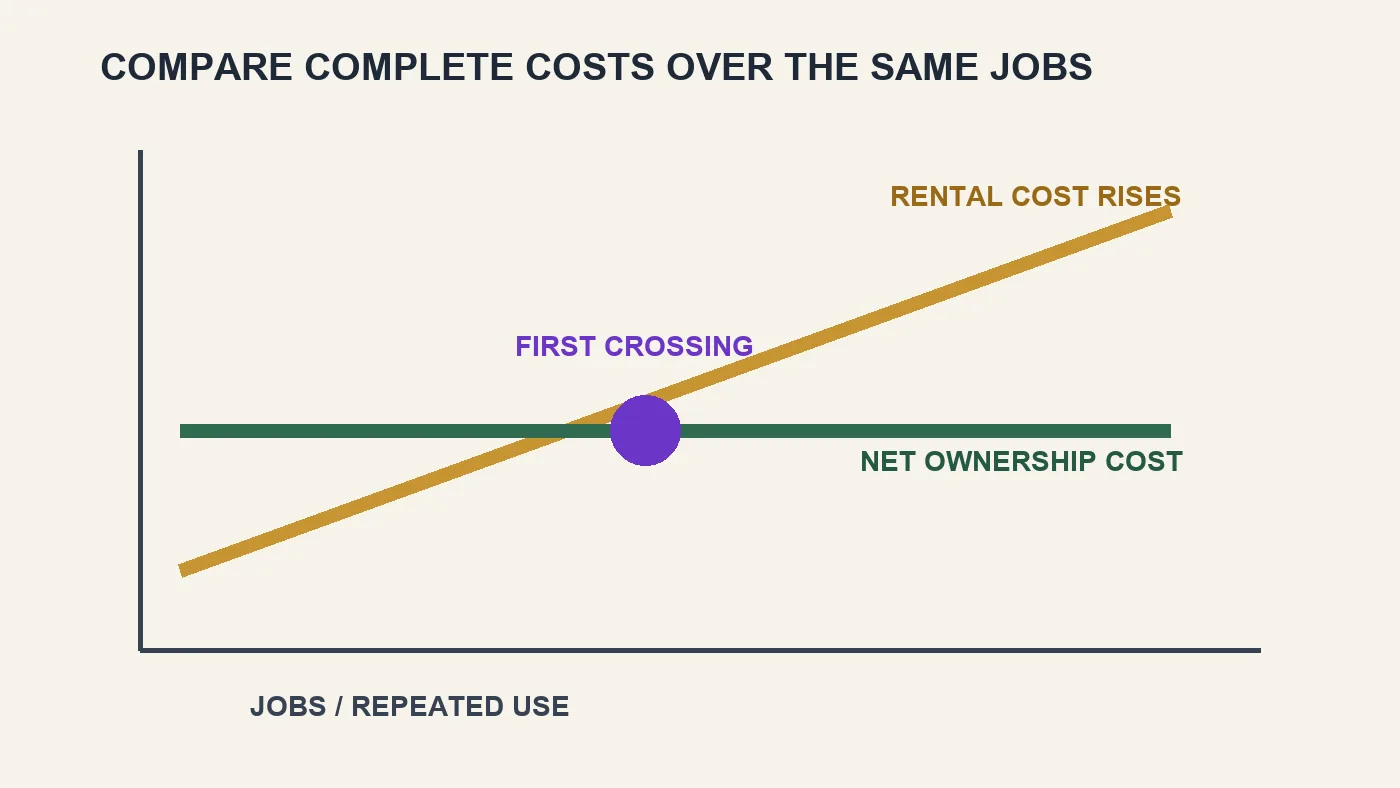
Hire cost = booking charges plus genuine hire extras. Net ownership cost = purchase and ownership extras minus realistic resale. Compare them over the same number of jobs, while separately checking capability, availability, downtime and the cash needed up front.
Make sure the two tools are genuinely comparable
A compact retail machine and a professional rental unit may have different capacity, accessories, duty cycle or dust control. A price comparison is meaningless if one cannot complete the specified work at the planned productivity and quality. Confirm power supply, working width, consumables, transport weight, operator requirements and suitability before entering prices.
Use actual written quotes with consistent tax treatment. Rental periods are chargeable periods, not just trigger time. Collection Friday and return Monday may create a different charge from one operating day. Purchase offers may exclude delivery, batteries, blades or extraction that the rental package includes.
How to use the hire-versus-buy calculator
- Tool and currency: name the exact comparison and select the display currency. Currency choice does not convert prices.
- Number of identical jobs: enter how many comparable jobs belong in the decision horizon.
- Chargeable days per job: use whole days invoiced by the supplier, including the booking terms you actually face.
- Daily hire and purchase price: enter current comparable quotes with tax handled consistently.
- Seven-day pricing: enable this only when the supplier permits the daily/weekly combinations being modelled. Enter the quoted seven-day block.
- Booking pattern: default mode returns the tool after each job. Enable continuous hire only when you will keep it, then enter chargeable idle days between jobs.
- Hire extras: add combined delivery/collection per booking, surcharge on hire charge, and consumables per used day when they are not already included.
- Ownership extras: add purchase delivery once, owner consumables per used day, maintenance per job, and a fixed horizon cost such as assessed storage.
- Resale: enter conservative expected proceeds at the end of the chosen horizon. Resale reduces net cost later; it does not reduce the cash needed to buy.
- Compare and print: read both the current scenario and repeated-use table, then save the assumptions with the quote date.
Worked example: three two-day jobs
Assume three identical jobs, two chargeable days per job, a $50 daily hire quote and a $500 purchase price. Leave every optional section off.
- Used hire days: 3 × 2 = 6 days.
- Hire cost: 6 × $50 = $300.
- Ownership cost: $500.
- At three jobs, hiring is $200 lower.
- Each additional identical job adds $100 hire cost.
- At five jobs, hire and purchase both total $500: the first tie.
Enter USD, 3 jobs, 2 days, $50 per day and $500 purchase. The live calculator should report $300 hire, $500 ownership, hiring lower by $200, and five jobs as the first count where ownership is no higher.
Why the first crossing is not a permanent law
People often call the first tie “the break-even point.” That is useful shorthand, but stepped tariffs can create local changes. A weekly block can suddenly make one longer booking cheaper than several daily charges. Resale may also fall as use increases, while maintenance may rise. The calculator searches whole job counts using the assumptions entered; it does not promise that those assumptions remain true forever.
Review the scenario table and rerun low, expected and high-use cases. If future jobs are only possible leads, do not value them like signed work. A purchase justified by ten hoped-for jobs is exposed when only four arrive.
Daily rates, weekly blocks and separate bookings
Suppose daily hire is $40 and a permitted seven-day block is $150. Five daily charges would be $200, so one block is cheaper. The calculator can select that combination. It does not pool separate returned bookings into one imaginary week. Three independent two-day hires remain three bookings unless you deliberately model keeping the tool.
Read the supplier’s definitions. A “week,” a seven-day block and a five-working-day promotion are not automatically equivalent. Model only terms you can actually buy and include late-return exposure in your operational plan rather than inventing an average penalty.
Return after each job or keep it between jobs?
Returning can repeat delivery and collection but avoids paying for idle gaps. Continuous hire can reduce booking fees yet charge for days when the tool is parked. For three two-day jobs separated by one idle day between jobs, continuous possession covers eight chargeable days: six used plus two gaps.
Consumables in the calculator apply to used days, while hire applies to held days. That distinction matters for abrasive machines, breakers and cleaning equipment. Compare both booking patterns instead of assuming fewer deliveries must be cheaper.
Rental extras that are easy to miss
- Delivery and collection for every separate booking.
- Damage waiver, insurance or other percentage surcharge where it is actually charged.
- Blades, abrasives, fuel, cleaning materials or wear charges not included in the base rate.
- Required accessories and attachments.
- Labor and vehicle time for collection, loading, return and cleaning.
- Downtime risk if the required unit is unavailable on the planned date.
A refundable deposit is a temporary cash requirement, not a consumed cost, so it is not added automatically. A non-refundable fee is a real cost and belongs in the appropriate input.
Ownership costs beyond the purchase price
Ownership can include delivery, consumables, maintenance, inspection, repairs, storage, transport, insurance and finance. The calculator provides clear fields for the simpler job-level comparison; add other assessed whole-horizon costs without counting them twice. NECA’s equipment guide similarly identifies maintenance, storage, handling, insurance, taxes and interest as ownership considerations, while noting that delivery and some field costs may sit outside its published rates.
Expected resale is uncertain. Run a conservative case and a zero-resale case. Keep gross cash outlay visible: paying $500 today and receiving $150 later is not the same cash-flow event as spending $350 today.
Consumables must be compared consistently
If both options use identical abrasives at the same price, consumables do not change which option wins, but they still matter to the job quote. Differences arise when the rental includes accessories, mandates supplier consumables or uses a different size. Enter per-used-day costs on both sides using the actual package.
Operator labor usually belongs in the project estimate rather than ownership cost because the job needs an operator either way. Delivery time can differ and may deserve a separate labor line. Use the labor-hours and duration guide to schedule collection, setup and operation without hiding them inside a tool price.
Practical factors the arithmetic cannot price for you
Cost is only one decision axis. Check storage security, transport, maintenance capability, inspection responsibilities, availability, backup support and how quickly technology or job requirements may change. A rarely used specialist machine can be cheaper to access through rental even when the simple purchase division looks close. An owned everyday tool may reduce scheduling friction, but downtime and repair responsibility move to the owner.
United Rentals recommends comparing historical maintenance and total ownership cost with the rental cost of equivalent equipment over the same period. That evidence-based approach is stronger than a generic utilization rule. See its rent-or-buy overview and the NECA Tool & Equipment Rental Guide summary.
Turn the decision into a job allowance
After selecting the better scenario, transfer only the cost that belongs to the job. A rental booking can be a direct job cost. An owned tool may need a reasoned internal usage allowance rather than charging the full purchase to one customer when the decision assumed repeated use. Keep the method consistent and visible.
Build the wider quote with the job price calculator, confirm crew and dates in the labor and duration calculator, and use the pressure-washing calculator when testing an equipment-heavy cleaning example.
A decision checklist before you book or buy
Start with the next confirmed job, not a vague intention to use the tool someday. Write down the required capability, the planned operating days and the latest date the equipment must be available. Obtain one rental quote and one purchase quote for genuinely comparable specifications. Ask what each price includes, when the hire clock starts, the return deadline, cleaning requirements and what happens if the machine fails.
Next, choose a sensible decision horizon. For occasional work it might be the next twelve months; for a short run of signed projects it might be those projects only. Count confirmed jobs separately from probable enquiries. Run the calculator once with confirmed work and again with the additional opportunities. If buying wins only in the optimistic case, the result should be treated as a forecast rather than a saving already secured.
Test the answer under three scenarios
- Low-use case: confirmed jobs only, conservative resale and a repair allowance.
- Expected case: the workload you can reasonably support with evidence and current quoted prices.
- High-use case: extra jobs, while checking that maintenance, transport and storage still remain realistic.
If the same option wins all three, the financial decision is robust. If the answer changes, identify the assumption at the switch. That may be the fifth job, a weekly rental block or resale above a particular amount. Knowing the switch is more useful than pretending one result is certain.
Keep a small evidence file
Save the dated quotes, calculator printout, included accessories, assumed job count and resale basis. If you buy, record usage, maintenance and downtime. If you rent, record invoiced days, delivery charges and return effort. Review the decision after several jobs. The purpose is not to prove the original choice right; it is to improve the next choice with actual costs.
Finally, protect the job itself. Reserve critical rental equipment early and confirm transport. For owned equipment, check service condition, required inspection and spare consumables before the start date. A theoretically cheaper option that delays the crew or cannot perform the work is not the cheaper project decision.
Frequently asked questions
How many rentals make buying worthwhile?
There is no universal number. Divide complete net ownership cost by complete cost per comparable rental as a first check, then model the actual booking pattern and extras.
Should I use daily or weekly hire prices?
Use the cheapest combination your supplier genuinely permits for each booking. Do not invent pooled discounts across returned hires.
Does resale reduce the purchase price?
It reduces eventual net ownership cost. It does not reduce the initial cash outlay or guarantee the expected proceeds.
Should refundable deposits be counted as cost?
Not as consumed cost, but record the temporary cash requirement. Include any non-refundable fee separately.
Do consumables belong on both sides?
Yes when each option requires them. Use actual package inclusions and per-used-day costs so the comparison is consistent.
What does “keep between jobs” mean?
It models one continuous booking and adds entered idle days between jobs. This can save repeated delivery while increasing chargeable hire time.
Is the first tie the permanent break-even point?
Not necessarily. Weekly tariffs, changing maintenance and declining resale can produce later changes. Review the scenario table.
Does the calculator include finance or tax deductions?
No. Keep tax treatment consistent and obtain suitable accounting advice for depreciation, finance and business tax questions.
Should operator labor be included?
Usually compare operator labor in the project plan because both options require it. Add only labor differences caused by collection, setup, maintenance or transport.
How often should I rerun the comparison?
Update it when quotes, confirmed workload, booking terms, maintenance experience, resale expectations or equipment capability changes.