

A hole that measures four cubic yards does not necessarily produce four cubic yards to haul away. Once soil is excavated it can occupy more space, and the truck may reach its weight limit before its body is full.
The excavation calculator keeps measured digging, loose spoil, retained material and removal loads separate. Here is how to build an estimate that a contractor or disposal provider can actually interpret.
Keep three material states on the page
In-situ, also called bank, volume describes material in the ground before excavation. On US quotes you may see BCY for bank cubic yards and LCY for loose cubic yards; confirm the basis rather than accepting an unlabeled “yard.” Loose volume describes it after digging. Compacted volume describes material after placement and compaction. These are different quantities even when they refer to the same original material.
Caterpillar’s earthwork reference distinguishes these states and notes that material characteristics vary. Use project-specific information for the bulking assumption; a general soil description cannot establish an exact factor for your site.
Write the basis beside every quantity and price. A digging rate per bank cubic yard and a disposal rate per loose cubic yard should not be multiplied by the same number simply because both say “per yard.”
A 12-by-10-foot excavation example
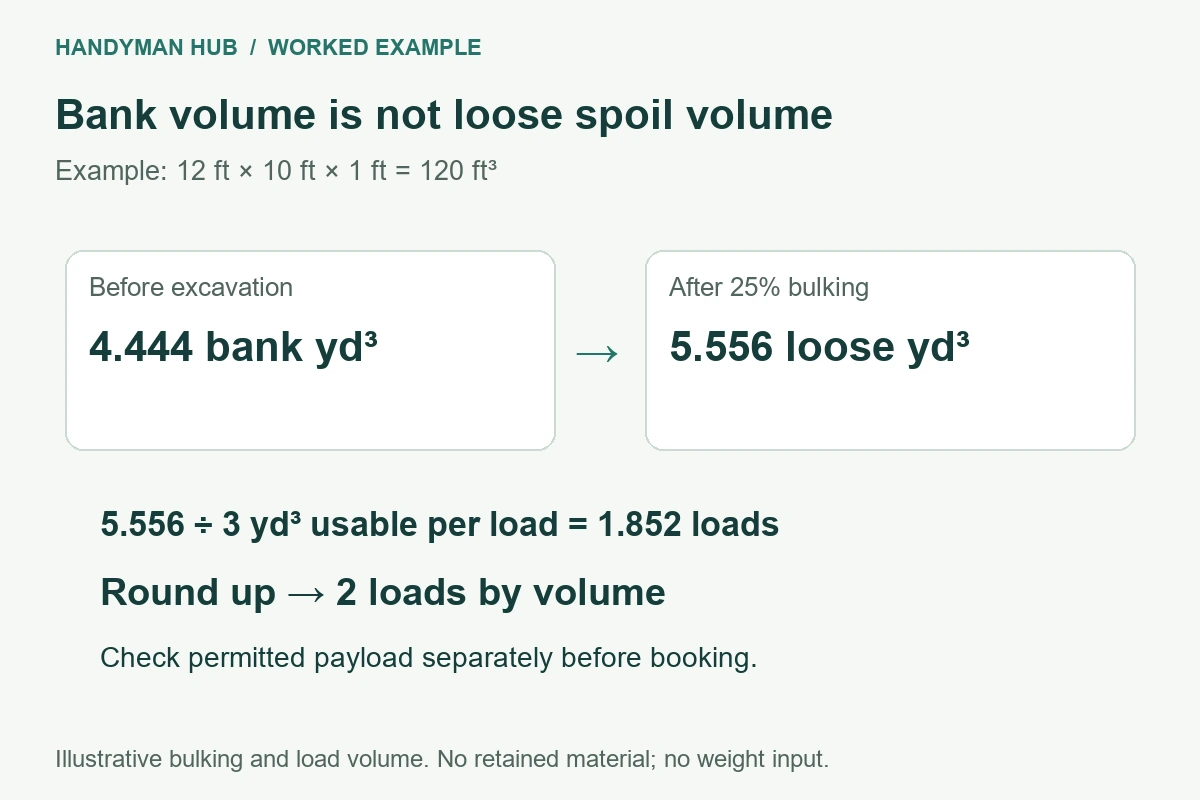
Suppose a checked excavation plan contains one rectangular section 12 feet long, 10 feet wide and 1 foot deep. Its bank volume is 120 cubic feet, or 120 ÷ 27 = 4.444 cubic yards.
For the example only, enter a 25% bulking increase and retain none of the material. Loose spoil becomes 4.444… × 1.25 = 5.556 cubic yards, rounded. The live calculator returns those figures. The one-foot depth and rectangular shape are quantity inputs, not a safe excavation specification.
| Stage | Example quantity |
|---|---|
| Measured ground before digging | 4.444 bank yd³ |
| After illustrative 25% bulking | 5.556 loose yd³ |
| Retained material | 0 |
| Export quantity | 5.556 loose yd³ |
If the permitted usable volume per load were 3 cubic yards, the volume calculation would require two loads. We checked that result in the tool. Payload was left blank, so this is a volume-only result, not confirmation that two actual vehicle trips are sufficient.
Check weight separately from body capacity
Bulking creates a larger volume for the same mass; it does not create extra soil weight. To estimate weight, this tool uses in-situ volume and an in-situ bulk density. Its density field remains in kilograms per cubic meter even when the dimensions use feet and the result uses US short tons.
Do not paste a loose-material density into that field without converting the basis correctly. Ask the source of the density whether it describes undisturbed, loose or compacted material, and record its moisture assumptions where available.
When a permitted payload is entered, the calculator compares whole loads by volume with whole loads by weight and takes the larger count. A truck’s nominal body size is not the same as its available payload for this material. Confirm both with the provider rather than filling a vehicle to its visible rim.
Retained spoil still has to be excavated
If part of the material will remain on site, subtract it from export, not from the digging quantity. In the example, retaining 20% would leave 80% for removal. Exported loose volume would become 5.556… × 0.8 = 4.444 cubic yards.
That calculation does not establish whether the retained material is suitable as fill, where it can be stored or how much compacted space it will occupy later. Keep the reuse specification and placement estimate separate from the removal calculation.
Different material streams may also need separate trips. The tool pools compatible export quantities when estimating loads. If topsoil and another material must remain segregated, run separate estimates or revise the haulage plan instead of assuming every partial load can be combined.
Measure the actual excavation shape
A building footprint is not automatically the excavation footprint. Designed working room, edge details and differing depths can change the quantity. Use dimensions from the checked plan rather than adding an unexplained percentage to cover every unknown.
Split irregular areas into non-overlapping sections. At intersecting trenches, count the shared volume once. For varying rectangular top and bottom dimensions, use the relevant pit mode only when its aligned, straight-sided geometry matches the plan. Entering those dimensions does not determine safe slopes or support.
Confirm acceptance before comparing disposal prices
Ask the receiving facility what it accepts, what information or testing it requires, and whether the quoted price includes hauling. Acceptance rules can be very specific. For example, Washington Rock’s disposal page describes commercial material requirements and says it does not accept soil or concrete from personal residences. That is a useful reminder to verify your actual destination before booking transport.
Before digging, follow your state’s 811 utility-locating process. Excavation stability, access, groundwater and nearby structures also need competent planning; the volume estimate does not resolve them.
Connect removal to the material going back in
Use the aggregate calculator for specified replacement layers and the concrete calculator for the actual pour geometry. For a wider build, the home addition planner can hold the separate work packages. Keep a bundled excavation quote separate from haulage or equipment already included in it.
Related project planning
For an addition project, the home addition budget checklist helps keep design, excavation, foundation and other packages visible. Check the quoted scope before adding a separate disposal allowance to an excavation price that already includes removal.





[…] Excavation quantities […]